
Market entry research: choose the first market you can test
A meal-planning service shows how local buyers, payment routes and unit economics shape the choice of a first market.

Market entry research helps a business decide where to enter, which offer to take and how to reach customers there. Start with a market in which the product can actually be used and bought. For a meal-planning service choosing a second country, that means looking beyond the size of the audience.
About this example: the service and market conditions below are illustrative. Households buy groceries separately. The financial values are stated assumptions for a small local pilot, with unspecified costs excluded.
A promising audience needs a working offer
The service plans several dinners a week and provides a shopping list. In Market A, the recipes use available ingredients and customers can pay through a usable route. In Market B, the audience looks appealing, but recipe supply and payment terms are unresolved. That difference belongs at the start of the entry decision.
First define who can use the service: households planning the coming week's dinners, with someone who helps choose the meals. Check ingredients, dietary needs, shopping routines, language and competing options. Our geographic segmentation guide explains how location can change an offer without turning a country into a single type of buyer.
Entry gate | Required evidence and insufficient substitute |
|---|---|
Eligible and reachable audience | Evidence needed for the meal-planning pilot: Defined households and actual acquisition route Insufficient substitute: A national internet-user total |
Usable localized offer | Evidence needed for the meal-planning pilot: Ingredient availability, recipe fit and language checks Insufficient substitute: A translated home-market card alone |
Payment and operations | Evidence needed for the meal-planning pilot: Confirmed terms, support capacity and appropriate local review Insufficient substitute: General country-business context |
Customer proposition | Evidence needed for the meal-planning pilot: Understanding, alternatives and response to complete terms Insufficient substitute: Population growth |
Pilot economics | Evidence needed for the meal-planning pilot: Actual costs, activation, payments and retention Insufficient substitute: A stated-interest multiplier |
A requirement can rule a market out of the current pilot without ruling it out forever. Record the problem and the fact that would reopen it. For Market B, that is a feasible recipe offer and payment route.
What the market figures can tell you
Population data can help describe the setting. Competitor pages can show the offers buyers already see. Neither tells the team how many households will pay for this service. Use each source for the question it can answer.
Evidence layer | Source and evidence boundary |
|---|---|
Population and economic context | Useful starting source: World Bank Open Data and the relevant national statistics office What it does not establish: Exact demand for your product |
US establishment context | Useful starting source: Census County Business Patterns, where the industry coverage fits What it does not establish: A count of all buyers or nonemployer businesses |
Country business environment | Useful starting source: International Trade Administration country guides What it does not establish: A substitute for current local legal, tax or operational advice |
Competitor offer | Useful starting source: Official local product and purchase pages What it does not establish: Competitor sales, profitability or customer satisfaction |
Audience understanding and choice | Useful starting source: Appropriately designed local human research or a disclosed modeled study What it does not establish: Observed purchasing or retention without behavioral evidence |
Commercial feasibility | Useful starting source: Quotes, actual pilot records and unit economics What it does not establish: A guaranteed national rollout outcome |
Keep the year, geography and unit beside every figure. Adults, households and business establishments are different bases. Google Trends can help explore search interest, but search activity is another measure again. Do not combine unlike totals into a demand estimate.
View an example study to inspect the audience, offer and findings before planning your own.
The pilot needs 1,000 retained subscribers to cover the stated costs
In the example, each retained subscriber leaves $6 a month after the per-subscriber costs included in the calculation. Against $6,000 of recurring local cost, that creates a break-even requirement of 1,000 retained subscribers in a month, before unspecified costs. The $6 is contribution, not the subscription price. No further cost breakdown is available.
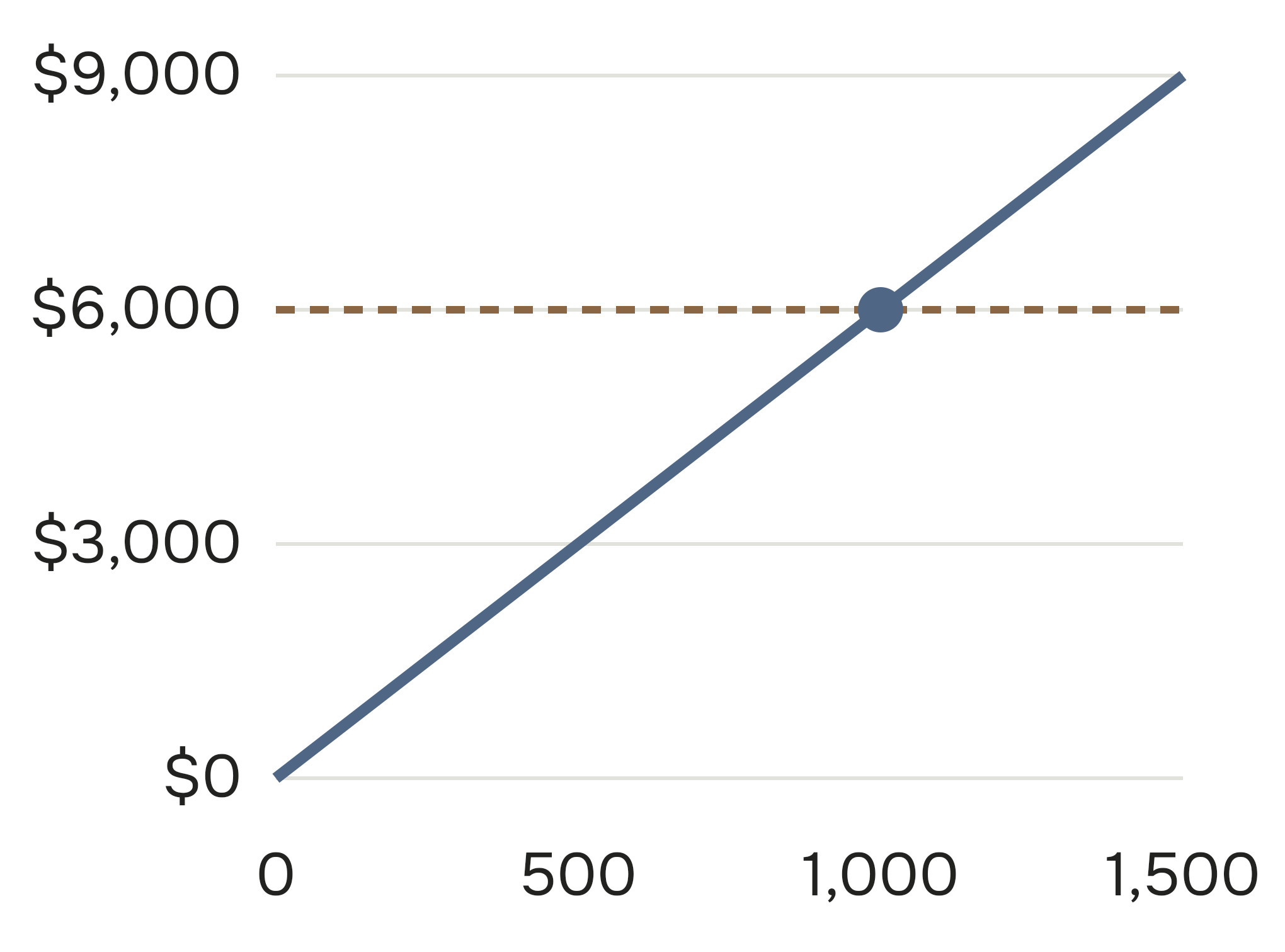
The full-size figure shows that arithmetic. It gives the pilot a target to investigate, not evidence that those customers can be acquired or retained.
Work forward from the eligible audience through reachable share, trial, paid conversion and retention. Give each rate a source or label it as an assumption, and keep the period and base consistent. Low, central and high scenarios can show which uncertain stage matters most. A household renewing a subscription is not a newly acquired household.
Market | Conditions |
|---|---|
MARKET A / FIRST PILOT CANDIDATE | Available ingredients. Usable payment route. Complete local offer, terms and operating checks still require approval. |
MARKET B / REOPEN WHEN READY | Resolve recipe supply and payment terms. |
A market-sizing worksheet the next person can reproduce
The 1,000-subscriber requirement becomes useful when the team can trace a possible route to it. A national audience total doesn't do that. For this meal-planning pilot, the starting unit is a household that meets all the service conditions together: in the launch area, able to use the recipes and payment route, and responsible for planning relevant meals.
If 60% meet one condition and 50% meet another, multiplying the percentages assumes a relationship the sources may not support. Request a joint count or cross-tab, use a defensible linked source, or leave the combined eligibility unresolved. Never treat the number of generated profiles in a synthetic study as the number of households in the market.
Use a source ledger beside the calculation. Each row needs a source URL or file and table, source version and retrieval date, geography, period, unit, eligibility definition, value or range, and the decision to include, replace or exclude it. Record why two apparently conflicting totals differ. A count of adults in a national survey cannot silently replace households in the service area; an older national estimate is context until a supported conversion makes it comparable.
Worksheet input | Evidence that belongs beside it |
|---|---|
Jointly eligible households | A source or linked calculation covering the combined conditions, with duplicates and uncovered areas identified. |
Reach in the launch window | The actual acquisition route and unique eligible households it could reach, rather than impressions or all website visits. |
Trial and payment | Observed rates from a comparable offer and route, or explicit planning assumptions pending a pilot. Save each numerator, denominator and window. |
Retained paying households | A defined status on a stated date among the paid cohort. Free users and canceled subscriptions don't satisfy it. |
Contribution and recurring cost | The costs included in each figure, currency, period and quote or operating record. Keep missing costs visible. |
The following additional planning inputs make the arithmetic reproducible. Reach, trial and payment refer to the first 30 days of the pilot. Retention is the proportion of those paid households still subscribed on day 90. The output asks what one subsequent full month would contribute if those households stay subscribed at the stated $6 contribution. It excludes later acquisition, further attrition and the unspecified costs already noted above.
Import this CSV at cell A1. Columns B, C and D are low, central and high planning cases. These are assumptions to replace with evidence, not measured market estimates or confidence limits.
input,Low,Central,High,unit_and_base
Jointly eligible households,80000,100000,120000,unique households meeting all conditions
Reached share,0.15,0.20,0.25,share of eligible households reached in days 1 to 30
Trial share,0.08,0.10,0.12,share of reached households starting a trial by day 30
Paid share,0.40,0.50,0.60,share of trial households paying by day 30
Retained share,0.40,0.50,0.60,share of paid households still subscribed on day 90
Monthly contribution per retained household,6,6,6,USD per retained household for one subsequent full month
Recurring local monthly cost,6000,6000,6000,USD in that same month
Put the following labels in A10:A18 and formulas in C10:C18. Copy the formulas across to B and D to evaluate the other cases. Row 10 checks that the seven inputs are numeric, the rates are within zero and one, household and cost inputs are nonnegative, and contribution is positive. Format household outputs as numbers and money as USD; retain full precision in the calculation.
Row and output | Central-case formula |
|---|---|
10: Inputs usable |
|
11: Reachable households |
|
12: Trial households |
|
13: Paid households |
|
14: Retained households on day 90 |
|
15: Subsequent monthly contribution |
|
16: Contribution less recurring local cost |
|
17: Required retained households |
|
18: Retained-household gap to requirement |
|
The central case gives 20,000 reached, 2,000 trial, 1,000 paid and 500 retained households. Their $3,000 monthly contribution is $3,000 below the stated recurring cost. The low and high cases give 153.6 and 1,296 retained households, respectively. Fractional households are expected counts from planning arithmetic; don't present them as observed customers. The high case combines several favorable inputs and isn't evidence that the market will reach break-even.
Which assumption changes the entry decision?
Hold the central eligible audience, reach and paid rate fixed. Vary the trial and retention assumptions together:
Trial share of reached households | Retained households by retention assumption |
|---|---|
8% | Retention 40%: 320 Retention 50%: 400 Retention 60%: 480 |
10% | Retention 40%: 400 Retention 50%: 500 Retention 60%: 600 |
12% | Retention 40%: 480 Retention 50%: 600 Retention 60%: 720 |
Every cell is a retained-household count, calculated as 100000*0.20*trial_share*0.50*retained_share. None meets the 1,000-household requirement. Within this range, modest improvements to those two stages won't close the gap. The team should investigate the acquisition route, the offer's contribution or the recurring cost before treating a larger national audience figure as the answer.
Before sharing the worksheet, reconcile each stage to the previous one, keep all rates between zero and one, and make missing inputs unavailable rather than zero. Check currency and monthly periods against the cost quotes. Replace the assumptions after the pilot while keeping its original version, so an apparent change in opportunity can be traced to new evidence rather than an unnoticed change of base.
A translation can be clear while the offer is wrong
A clear translated card can still describe dinners households cannot make or a payment method they cannot use. Review local ingredients, meal routines, support and alternatives before comparing reactions. Keep the complete offer visible: recipes, approved local-currency charge, billing period, renewal or cancellation conditions and trial terms. Say plainly that groceries cost extra.
The Cross-Cultural Survey Guidelines describe a team process of translation, review, adjudication, pretesting and documentation. Review the question and response options as carefully as the product card. A fluent translation can still ask a different question.
Pretest with relevant people in each language and the intended research format. Ask what the service includes, what they would buy separately and which period their answer covers. The Guidelines' cognitive-interviewing chapter includes checking translated answer scales and options. Giving both markets a five-point scale isn't enough on its own.
If one person reads 'shopping list' as an order to be delivered and another reads it as a list to take to the store, fix the meaning before interpreting a preference gap. That is a wording problem to investigate, not evidence about a national personality. A small pretest can find problems; it cannot measure national demand.
What a pilot in Market A should answer
A is the first pilot candidate once the complete local offer, terms and operating checks are approved. Record how eligible households reach the offer, activate, pay and remain subscribed over a declared period. Add actual acquisition, delivery and support costs to the economics. Decide the stop, revise and expansion rules before seeing the results.
The report should explain which offer and route were tested, where households dropped out and what the team should change. If payment works but retention fails, another round of audience sizing won't repair the service. Use product-market fit research to investigate whether the offer solves a problem worth returning for.
Reopen B when its recipe and payment routes work. Compare equivalent complete offers with relevant households in both markets; then investigate local routines or alternatives behind any remaining difference. Keep actual customer understanding and purchases separate from modeled reactions.
Vensia can help compare modeled local offer, price and audience responses and explore the reasons behind them. Confirm the market, language and audience evidence with the team. The service does not imply coverage of every geography. Use concept comparison methods for the offer choice and pricing research for the price question.
For this service, A is worth preparing first because households can obtain the ingredients and use its payment route. Confirm the remaining terms and operating checks, then use actual acquisition and retention to test whether the 1,000-subscriber requirement is reachable. Keep B open as a later option with explicit recipe and payment conditions.
