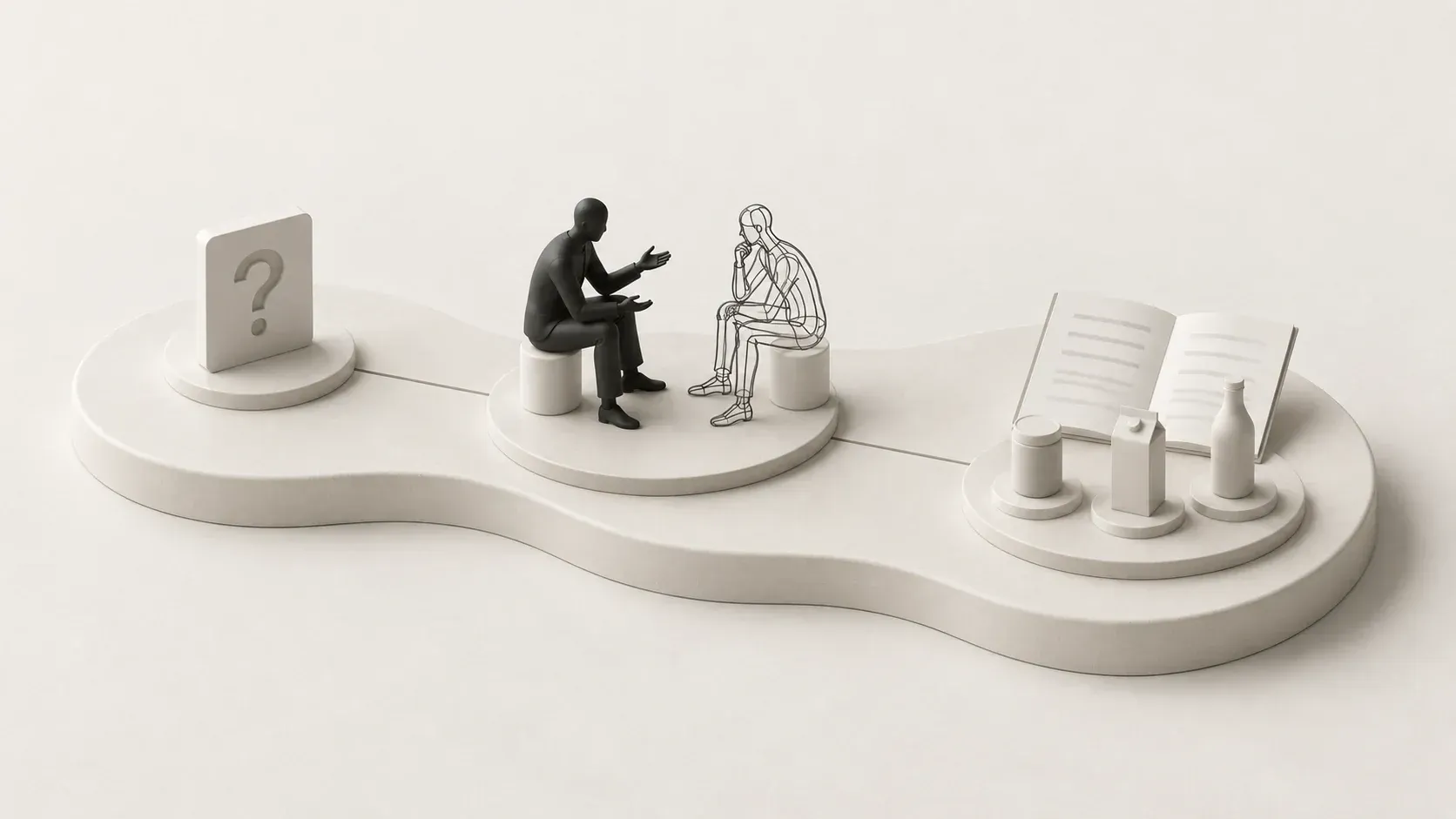
Name testing: choose the name buyers can understand and remember
A meal-planning service compares three names for spoken referrals and encounters with supporting copy. The useful shortlist pairs each name with the explanation buyers will actually receive.

Name testing compares what buyers think a name means, how it fits the offer, how they say it and whether they remember it. In this illustrative exercise, a meal-planning service is choosing between “Weekplate,” “Dinnerpath” and “Pantryloop.” The decision depends on what buyers will encounter first: the name alone or the name with a category line and explanation.
Weekplate makes one buyer expect ready-made meals until the description explains planning and a grocery list. That reaction raises a practical question: can the launch reliably supply the explanation the name needs? Keep name-only meaning separate from meaning after explanation, and complete linguistic, availability and professional clearance checks for the intended markets.
A name that works with supporting copy may fail in a spoken referral. Start with the acquisition route the launch will actually use, then test the information available there. Keep meaning and recall visible together; remembering the wrong service is a costly kind of memorability.
Matched cards separate the name from its explanation
Weekplate before and after the description
Weekplate
“Sounds like ready-made meals.”
A service that prepares a weekly dinner plan and a consolidated shopping list. You buy the groceries separately.
Prepare two saved stimulus stages. First show a name-only card for Q1–Q2, with identical type, size and layout and no description or tagline. Then reveal the same description for Q3 onward: “A service that prepares a weekly dinner plan and a consolidated shopping list. You buy the groceries separately.” Keep the description treatment identical too. Do not give one name a persuasive tagline or more attractive artwork.
If the first encounter will be a spoken recommendation, include an audio or interviewer-administered condition with consistent pronunciation. A text-only test does not establish whether people understand a name when hearing it.
Seven questions, with the first interpretation preserved
Show one candidate first, using randomized assignment for initial measures. Avoid presenting the full list before measuring first impressions.
- What kind of product or service would you expect from this name? Open response before the description.
- What comes to mind when you see the name? Open response; ask for both favorable and unfavorable associations.
- After showing the description: how well does the name fit this service? Very poorly / somewhat poorly / neither / somewhat well / very well / cannot judge.
- How easy or difficult would you find it to say the name aloud? Very difficult / somewhat difficult / neither / somewhat easy / very easy.
- Does the name remind you of another product or organization? If so, which? Open response.
- After a defined intervening task, ask participants to recall the name without showing it again.
- In a later balanced comparison, ask which candidate they would investigate further, including “none” and “no preference,” then ask why.
For this implementation, hide the name and description after Q5, show a two-minute unrelated task with no names or meal-planning cues, then ask Q6 without returning to previous cards. Record stage, exposure ID and exact delay. Declare this convention before fieldwork. Short survey recall measures performance under that exposure; it is not a long-term brand-memory forecast. If participants see every candidate repeatedly, do not call the resulting familiarity an unaided first impression.
Meaning, fit and recall can disagree
Measure | Report and interpretation |
|---|---|
Category understanding | Report: Coded expectations and base Interpretation: Whether the name points toward the intended offer |
Associations | Report: Themes, examples and contradictory cases Interpretation: Possible benefits, confusion or unwanted meanings |
Fit | Report: Full response distribution Interpretation: Stated match with the supplied description |
Pronunciation | Report: Difficulty reports and any observed attempts Interpretation: Potential spoken-use barrier within the tested language |
Recall | Report: Exact/accepted matches divided by eligible exposed participants Interpretation: Recall under the specified study exposure |
Preference | Report: Choice shares with “none” retained Interpretation: Comparative stated choice under this presentation |
Agree the coding rules before reviewing candidate rankings. For these names, spelling variants might count as recall if they unambiguously identify the candidate; document the rule. Do not change it to rescue a preferred name.
The coding record has two stages: “Weekplate sounds like ready-made meals” before explanation, and “I understand that I buy the groceries” afterward. The first exposes a risk in a name-only encounter; the second can make a complete treatment worth comparing. Preserve both so a favorable fit score cannot erase the category problem.
How the description changes the meaning
Use the patterns below to decide which part of the naming system needs work. Revising the description, developing a more distinctive name and checking spoken understanding are different next steps.
Pattern to look for | Decision and next comparison |
|---|---|
Memorable but wrong category | Decision implication: Initial encounters may create a false expectation Next comparison: Compare a clarifying description or another name under the actual first encounter |
Correct category but low recall | Decision implication: The name communicates but may be difficult to retrieve Next comparison: Inspect distinctiveness and spoken/text exposure separately |
Positive fit after explanation only | Decision implication: The description is doing important work Next comparison: Test the realistic encounter with the information actually available |
Association with another brand | Decision implication: Confusion or familiarity may affect preference Next comparison: Investigate the association and obtain separate professional clearance |
Keep stage, candidate and exposure IDs in the analysis. Name-only association, description-assisted understanding and delayed recall are different measures. Report them beside each other rather than averaging them into a score whose weighting determines the winner.
Recall depends on a declared matching rule
For the stated two-minute delay, accept a variant only when the rule unambiguously identifies the candidate. Keep an exact match, accepted variant, wrong candidate, uncertain and missing answer distinct. Do not count a name retrieved after reopening the card as unaided recall.
The first encounter decides how much help the name gets
The two-stage instrument above diagnoses what a name means alone and how an explanation changes that reading. To compare complete first encounters, randomly assign buyers who have not seen the name-only cards to one of the three names with matched copy. Include the shared category line from the start, then ask what buyers expect before judging fit. For a launch driven by spoken referrals, prioritize hearing, pronunciation and unaided category inference. Save the content and exposure stage with each answer.
Use “Weekly meal plans and one grocery list” with Weekplate, Dinnerpath and Pantryloop, retaining the same full service description in each treatment. Ask what buyers receive and what they must do themselves before fit. If Weekplate still implies prepared meals, revise the name or category line. Among treatments that communicate correctly, compare associations and recall under the same exposure and delay.
Feature naming has an action and permission test
Inside the meal-planning service, the immediate job of a feature label differs from choosing the brand name. Here, delayed recall isn't the primary measure. The user needs to predict what will happen next, including whether another person will see or change their information.
Extend the meal-planning example to a shopping-list screen. The task is to let a household partner view the list while keeping editing control. The proposed function opens a confirmation dialog and then creates a read-only link; anyone possessing that link can open it. It doesn't send an email, invite an editor or order groceries. Those are the function and permission conditions to test before selecting its label.
Compare “Share list,” “Invite to shop” and “Create view-only link” in the same interface. Keep the nearby “Edit meals,” “Print list” and “Order groceries” controls visible, with the list's current saved state. A label isolated on a survey card can't reveal whether someone mistakes it for the neighboring order action. Give each comparable first-use group one label before showing alternatives.
Ask, before allowing a click: “What do you expect this control to do?” “Who would be able to open the list?” and “What would they be able to change?” Capture the answer without supplying the intended meaning. Then let the person complete the task in the prototype. Save which control they use, whether they inspect the confirmation and what they think has happened afterward. A correct explanation after the dialog doesn't replace the unaided label prediction.
Candidate label | Meaning and permission evidence to retain |
|---|---|
Share list | Does the person expect a link, an email or a public post? Do they assume viewers can edit? |
Invite to shop | Does “invite” imply a named person or editing rights? Does “shop” imply an order rather than a saved list? |
Create view-only link | Does the person understand link creation, read-only access and the remaining question of who can open it? |
The final confirmation can say, “Anyone with this link can view your grocery list. They can't edit it. Creating a link doesn't order groceries,” with “Create link” and “Cancel” as the actions. Test that full treatment too. A more explicit label may reduce one ambiguity while leaving the audience of the link unclear; supporting copy belongs at the point where that permission matters.
For the readout, keep one row per candidate, interface state and audience. Return the exposed base; predicted action coded as intended, email, editing invitation, order or other; predicted viewer access and editing rights; missing or uncertain answers; and observed task completion where a human prototype task was run. Preserve the answers behind every misunderstanding. Don't blend these measures into a single “name appeal” score.
This blank export keeps those questions inspectable. Code one primary action category per answer, preserving mixed or ambiguous explanations in the source text. Action, viewer-access and editing-right counts each use their own valid-answer base, with uncertainty retained as a response and missing answers reported separately. The task-completion base includes only people given the working prototype task.
candidate_label,interface_state,audience,exposed_n,action_answer_base,intended_action_n,email_n,editing_invitation_n,order_n,other_action_n,uncertain_action_n,action_missing_n,viewer_access_answer_base,anyone_with_link_n,invited_people_only_n,other_access_n,uncertain_access_n,viewer_access_missing_n,editing_rights_answer_base,view_only_n,can_edit_n,uncertain_rights_n,editing_rights_missing_n,prototype_task_base,correct_task_completed_n,source_answer_ids
W3C's guidance on headings and labels calls for labels that describe their topic or purpose. That is a useful design constraint; a preference for a label doesn't prove that it communicates this particular action. Check the control's visible wording and accessible name in the actual implementation as well as its behavior.
Choose the label and supporting permission explanation that help the intended user predict and complete the right task. If a person understands the function but rejects anyone-with-the-link access, naming has exposed a product-policy question. The repair may be restricted sharing rather than another word for the same permission.
Meaning can disqualify a memorable name
Agree the disqualifying error before reading the scores. For a name-only referral, a recurring wrong-category interpretation can exclude a candidate even if recall is strong. For a complete treatment, test whether the available copy carries the intended service clearly. Do not let a composite average trade that central meaning away for a higher preference rating.
The shortlist should name the encounter each candidate can serve and the fact still to resolve. A confusing association needs investigation; similarity to another organization needs separate clearance. A record of those consequences is more useful than a decimal ranking whose weights decide which launch risk the team will accept.
Choose the naming system your launch can support
For the description-bearing launch, compare the three complete treatments first. For the referral-led launch, favor a candidate that communicates planning without a later explanation, if the evidence supports it. The Weekplate answer diagnoses one weakness; it provides no measured winner among all three names.
Deliver the selected name with the category line, exact encounter, supporting results and unresolved checks. The creative team can implement that naming system; the launch team can judge whether its acquisition route reliably supplies the information the recommendation depends on.
Test across the languages and markets you intend to serve with appropriate human expertise. A model can suggest associations to investigate, but it cannot certify the absence of an offensive or confusing meaning. Keep professional legal clearance and availability checks in a separate workstream.
Vensia can compare modeled interpretations and objections across a defined audience and recommend a naming or supporting-copy direction within an agreed study. Bring the candidate cards to Vensia to agree the audience, first encounter and measures your decision needs, including whether the proposed recall design can be supported. For the surrounding proposition, see our message testing guide and our positioning research guide.
Related guides: concept testing; packaging design testing; claims testing; product launch research.
Copy these questions
These items come from the worked example above. Keep its complete offer, audience eligibility, response options and exposure rules when adapting the wording.
- What kind of product or service would you expect from this name? Open response before the description.
- What comes to mind when you see the name? Open response; ask for both favorable and unfavorable associations.
- After showing the description: how well does the name fit this service? Very poorly / somewhat poorly / neither / somewhat well / very well / cannot judge.
- How easy or difficult would you find it to say the name aloud? Very difficult / somewhat difficult / neither / somewhat easy / very easy.
- Does the name remind you of another product or organization? If so, which? Open response.
- After a defined intervening task, ask participants to recall the name without showing it again.
- In a later balanced comparison, ask which candidate they would investigate further, including “none” and “no preference,” then ask why.