
Omnibus research: know what your questions follow
A luggage-brand recall question comes first in its own block but follows another client’s brand list. The booking changes; the later offer diagnostic can still be useful.
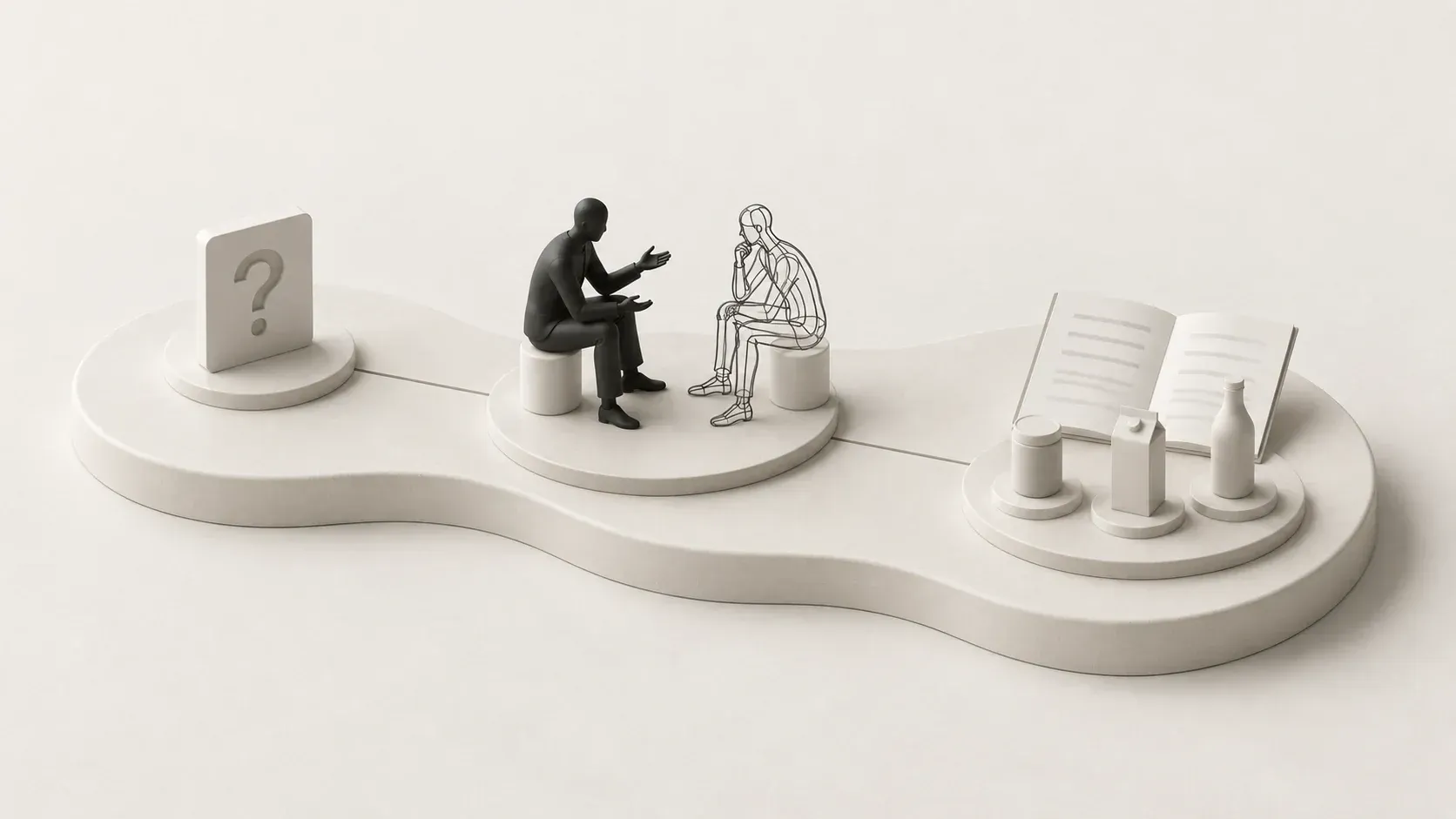
Omnibus research lets several clients buy questions in one shared survey. In this fictional booking, luggage brand North Quay wants an unprompted brand-recall baseline before showing a hard-shell carry-on concept with owner-replaceable wheels.
A recall question placed first in North Quay’s section may still follow a brand list in another client’s block. An open response format doesn’t make that encounter unprompted. The wording you control is only part of what respondents see.
Buy new questions in shared fieldwork
An omnibus lets you commission new answers to your questions while sharing survey operations with other clients. Kantar describes clients contributing questions to the same wave, pooling sample and fieldwork. Its service explanation includes question review, programming, tabulations and profiling variables or banners agreed with the client.
That is a different purchase from licensing an existing report or dataset. Our syndicated research guide explains how to assess the coverage, vintage, outputs and permitted use of a published product. An omnibus booking needs agreement about a new respondent encounter, including where your questions appear within it.
A short block can suit a focused question among an audience the supplier can reach. The shared arrangement becomes consequential when your measure requires an encounter the wider questionnaire might change. The question is whether the proposed wave can deliver that encounter for the people whose answers you will use.
Where the recall question sits in the full survey
The intended audience is US adults who bought cabin luggage in the past twelve months. North Quay needs their recall baseline, then feedback on information missing from the proposed offer.
North Quay submits an open question: “Which brands of cabin luggage, if any, come to mind?” It plans to show its own bag concept afterward and ask what someone would need to know before considering it. Fieldspan, its supplier, says the recall question will be first in North Quay’s block.
The test link shows a luggage-brand list in an earlier client's section. A redacted placement sheet confirms that this is one of the planned respondent routes. Fieldspan cannot demonstrate that the recall item will precede relevant brand cues across the eligible routes.
Item | Placement |
|---|---|
Earlier client section | A luggage-brand list appears on a planned route before North Quay's block. |
North Quay's first item | The open recall question is first within its block, after that earlier list. |
Offer feedback | North Quay's bag card and missing-information question follow the category discussion. |
The open response format has not removed the earlier cue. The answer would describe recall after the material respondents encountered. That does not tell North Quay how large an effect the list has, or which brands gain or lose mentions. It does tell the team that the demonstrated route fails its intended unprompted-by-this-questionnaire condition.
Our brand awareness research guide explains the measures and their interpretation. For this booking, the unresolved responsibility sits with the shared questionnaire: who can establish what comes before the measure, beyond the questions North Quay supplied?
North Quay needs a separate route for recall
Ask about the whole encounter relevant to the measure. An invitation can name a sponsor. A screener can display brands. A preceding client block can introduce the category or the exact alternatives you intend to ask people to recall. Define which cues would invalidate the intended interpretation, then ask how the provider will prevent them before the recall item.
The supplier may need to keep other clients' questions confidential. You can ask for a test route, appropriately redacted placement information and a written commitment covering eligible paths without demanding another client's responses or proprietary questionnaire. “First in your section” is insufficient when the required condition concerns the whole survey encounter.
Providers do acknowledge the issue. Meraki describes managing context between client sections, including block rotation where appropriate and buffer items. That is a stated process, rather than proof that a particular booking gives your item a clean first position. A buffer does not erase a brand list someone has already seen.
For North Quay, the supplier cannot demonstrate the required placement in this wave. The team removes the recall item before fieldwork and commissions it through a separately controlled route. That route still needs its invitation, eligibility questions and sequence checked; a dedicated study is not automatically free of relevant cues. For a separately commissioned study, our market research companies guide helps you compare partners by audience, evidence and deliverable.
North Quay keeps the other work only after changing its brief. It is no longer buying one block that supposedly provides both an unprompted baseline and an informed product reaction.
Work | Decision |
|---|---|
Unprompted brand recall | Decline this item in the proposed shared wave. Commission a route verified for the intended unprompted condition. |
Offer information gap | Keep a separate diagnostic after the bag card, with the preceding context documented. |
Future comparison | Agree the audience, wording and encounter before treating another wave as comparable. |
An informed response can be the right question
The earlier category discussion does not make every later answer useless. North Quay also wants to know what remains unclear once someone has considered cabin-bag features and seen its own offer.
It accepts a narrower question: “After reading this description, what information, if any, would you need before considering this bag?” The card explains the replaceable-wheel proposition. The brief states that respondents reach it after the documented category context. The output will help the team complete the product description.
North Quay accepts the shared setting because this diagnostic concerns the informed encounter. The answers will guide its product description, rather than establish what shoppers were already thinking or whether they will buy. If relevant earlier content differs across routes, retain that distinction and assess whether the responses can support the intended comparison.
The same discipline applies to questions framed as factual. Earlier material may change which products someone includes in a category or which experience they recall. Review the context required by the particular question instead of assuming that purchase-history or closed-response wording makes placement irrelevant.
The wave’s total sample is only the starting point
The total sample for an omnibus wave is not automatically the answering base for your questions. North Quay needs recent cabin-luggage buyers, rather than all adults simply because the wider wave reaches them. Confirm that the supplier can identify enough eligible people and explain any additional sampling or filtering required.
Kantar's omnibus explanation notes that targeting depends on how many people qualify and that niche audiences or deep subgroups can be unsuitable. Agree the relevant base before treating a broad sample description as an answer to your audience requirement.
Also agree the output. Ipsos KnowledgePanel's omnibus page describes data-tab delivery and lists custom banners, data files, analyses and oversamples as additional available options. Do not assume that an omnibus booking includes respondent-level files, every profiling variable or a history of earlier exposure.
North Quay needs the wording, eligible and answering bases, relevant weighting or exclusions, and the collection conditions for both studies. The separate recall study also needs placement information showing that the intended unprompted condition was met. A label such as “unaided” in a table can’t substitute for that information.
A recurring fieldwork schedule doesn’t establish continuity with the same people. If the question depends on how members learn across visits, our online research communities guide explains the continuing research program to assess. Ask an omnibus supplier about repeat-participant handling when it matters to the intended encounter.
A clearer offer supports a different comparison
Once North Quay has appropriate human awareness evidence and a clearer product description, its next question may concern the offer: how do relevant audiences respond to replaceable wheels, a lighter case or different explanations of repairability?
At Vensia, we build simulated audiences grounded in purchase, behavioral and research data. Your customer evidence and past research can add context. Our team builds the audience, runs surveys, interviews and comparisons, and helps interpret the responses. Follow-up questions to the same modeled audience can investigate the reasons reported for a difference.
Bring the intended buyers, complete alternatives and the research you can provide. Keep the input and exposure conditions clear as the study develops. A modeled comparison can explore how an offer is understood and considered; it does not measure current human unaided awareness or establish that a wheel is easy to replace in use.
Book a demo to plan a comparison of repairability descriptions for the intended carry-on buyers, using the research your team can provide.