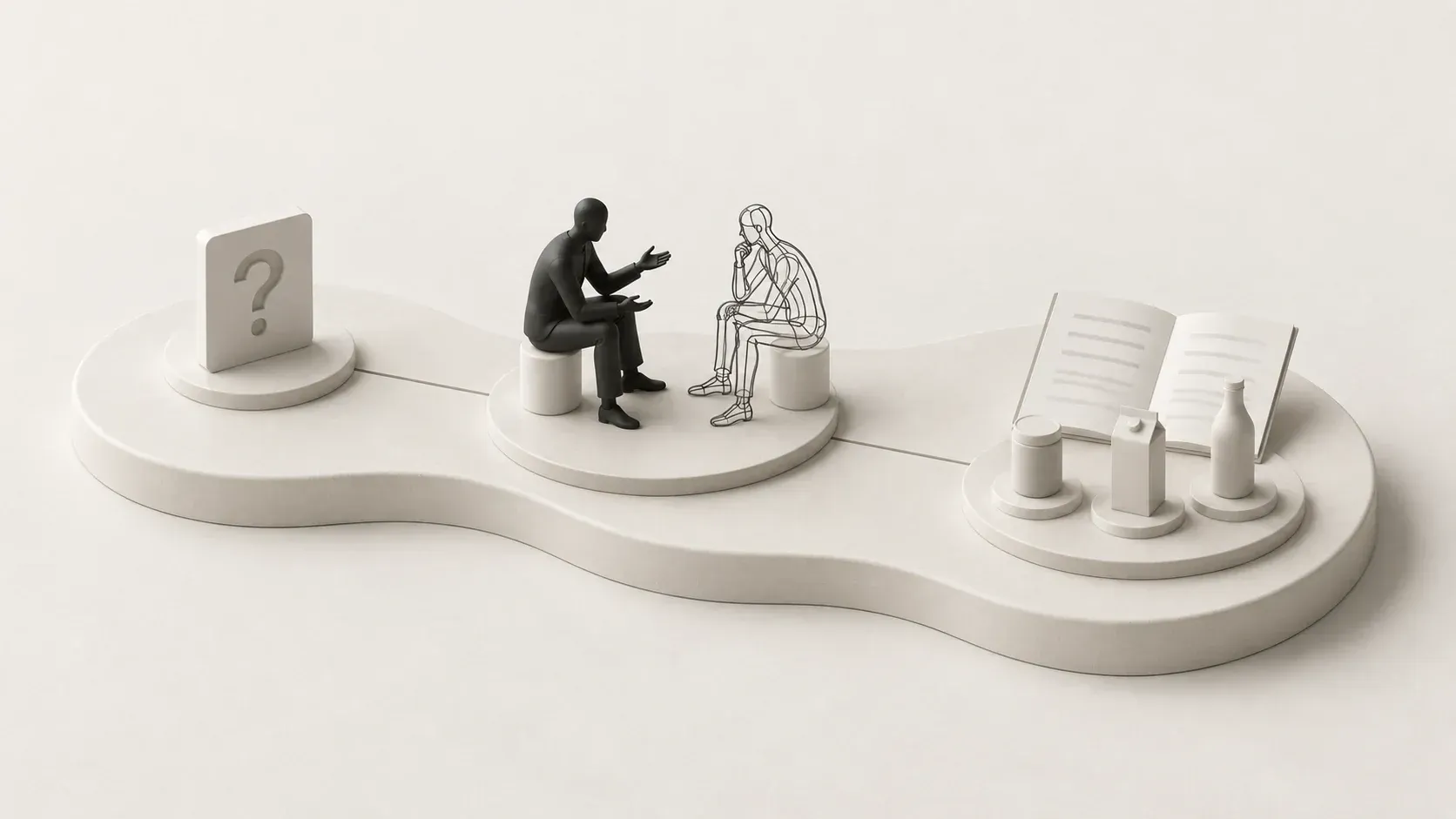
Qualitative market research: understand the experience that changes the decision
An across-town refill trip competes with the grocery routine. Follow the account, coding rule and contrary case into a specific channel question worth testing.

Qualitative market research investigates experiences and the reasons behind decisions through detailed accounts and observations. In this illustrative refill example, a customer keeps the reusable bottle but buys a disposable replacement during the grocery shop and describes the refill shop as “across town.” Before changing price or advertising, the seller needs to understand that purchase sequence and the alternatives that fit it.
Depth helps when the experience is unclear
“Would you like our new service?” asks for a hypothetical reaction. “Tell me about the last time you tried to solve this problem” opens an episode you can investigate. The second question helps you understand what happened before asking how an improvement might help.
The account explains why the extra trip mattered
“I kept the bottle by the sink, but the refill shop was across town. I bought the usual bottle while doing groceries.”
Codes: Container retained · extra journey · grocery substitution
Interpretation to investigate: Refill access competes with an existing shopping routine.
Contrasting episode: A continuer combines the refill trip with a family visit.
The journey was reported, not directly observed. Investigate the separate refill trip alongside the substitute that fits an existing grocery routine; “buyers want convenience” is too broad to choose an action.
Recruit across relevant experiences: people who refilled, delayed and abandoned. Document how you found them. Interviewing enthusiastic subscribers alone would leave the failure unexplained. The number of interviews should follow the diversity and depth required; there is no universal count that guarantees complete understanding.
The interview follows a sequence that a single rating can't supply: noticing the container is empty, considering another purchase, finding a route and choosing an alternative. It lets the analyst ask why an obstacle mattered in that situation. Use observation when the task itself needs checking and documents when records can corroborate the episode.
A discussion guide that keeps the journey intact
Explain the purpose, recording arrangements and voluntary participation before beginning. Do not ask participants to disclose information unnecessary to the decision.
Stage | Main question and follow-up |
|---|---|
Context | Main question: When did you last finish the original container? Neutral follow-up: What else was happening that week? |
Trigger | Main question: What did you do when you noticed it was nearly empty? Neutral follow-up: Walk me through the next step. |
Alternatives | Main question: What other options did you consider? Neutral follow-up: What made each possible or difficult? |
Process | Main question: How did you try to get a refill? Neutral follow-up: Where did you stop or change plans? |
Outcome | Main question: What did you end up using? Neutral follow-up: How did that work out? |
Meaning | Main question: What mattered most in that decision? Neutral follow-up: What makes you say that? |
Counterfactual | Main question: What would have needed to change for a different outcome? Neutral follow-up: Can you recall an occasion when that happened? |
Ask for concrete episodes before hypothetical improvements. If appropriate, invite the participant to show a receipt, reminder or empty container; secure permission and keep its provenance.
Neutral follow-ups ask the person to explain the next step or the evidence behind their answer. They do not reassure the participant that refilling is easy or teach the desired sustainability motivation. A volunteered solution should be connected back to the problem it would solve.
The interpretation needs a visible route back to the account
Use the account above to keep the evidence and your interpretation distinct:
Analytic layer | Entry |
|---|---|
Observed material | Participant’s stated account; no journey was directly observed |
Initial codes | Extra journey; grocery substitution; container retained |
Interpretation | Refill access may conflict with the existing shopping routine |
Competing explanation | Refill price or stock availability may also matter |
Negative case to seek | Buyer who travels the same distance and still refills |
Possible action | Test access through the existing grocery channel |
Keep a codebook: definition, inclusion rule, exclusion rule and example for each code. Let more than one code apply when the account contains multiple ideas. Have another analyst examine difficult excerpts and record disagreements instead of hiding them.
One code with a clear inclusion rule
Code: extra replenishment journey. Include an excerpt only when the buyer describes a separate trip or detour to obtain a refill. Exclude a general wish for convenience with no journey described. The “across town” excerpt qualifies. “It was expensive” does not qualify unless the account also describes the trip. A second analyst should record disagreement on ambiguous cases; the result is an inspectable interpretation, not a stronger story selected after the fact.
The original text contains a retained container, location obstacle and grocery substitution. Those details make the access explanation plausible. A broad theme such as “convenience” removes the event sequence and makes almost any marketing action look connected.
A buyer who kept refilling tests the explanation
A buyer who refills while visiting family nearby gives the explanation a boundary. Distance can be manageable when another errand already provides the route. Compare that account with the grocery substitution and ask about complete price, stock and instructions in both episodes.
The next decision is whether a feasible refill offer within the regular shopping trip merits a pilot before another sustainability campaign. It does not assume a new channel restores repeat use. Confirm availability and costs, compare interpretation of the complete alternatives and observe replenishment if the route is implemented.
A contrary case is valuable when it makes the next study more precise. If a buyer passes a stocked refill outlet but prefers another product for value reasons, the channel explanation needs to change. A buyer like that can teach you more than another quote about distance from people recruited the same way.
An explanation should change the channel or product decision
Request the journey, the accounts that support it, a contrary case and the action each explanation would change. Keep original responses and a concise coding rule so another reader can see why an episode qualifies. A theme count describes the studied accounts unless a separate measurement design supports a wider estimate.
For human fieldwork, use our qualitative research companies guide to assess recruitment and moderation responsibility. Use our quantitative research guide when you need a defined measure or mixed methods when the explanation and distribution must meet.
Vensia can use synthetic interviews to explore reactions to a defined refill offer and the objections it raises. See how Vensia builds populations and runs a study to assess which audience data and comparisons fit that job.
Discuss managed synthetic interviews with Vensia if you're choosing which refill route or message to investigate next. Keep those modeled accounts identified in the readout. Evidence that a real buyer made the journey must come from that buyer or relevant observed records.
Request a small set of well-supported patterns with episode evidence and exceptions, not a quotation anthology. Ask which product, channel or message decision each pattern changes and what remains unknown. That lets marketing use depth without converting interview counts into a population claim.