
13 Qualitative Research Companies in 2026: Methods & Services
Compare 13 qualitative research companies by audience, evidence source, interview method and deliverables. Find the right fit for your study.

Qualitative research companies supply services or software for investigating how people interpret a situation and make decisions. If buyers praise a product but stop buying it, your team needs to know whether price, alternatives or a changed routine explains the gap. Choose a provider by who reaches that audience, who conducts the research and who turns its source material into a recommendation.
This unranked comparison is organized by research job: agency-led studies, communities, fieldwork, specialist recruitment, researcher-operated software, AI-moderated human interviews and modeled audience studies. Human and modeled responses answer different questions; inspect the underlying accounts and agree what evidence supports the decision.
Compare the companies · See our modeled research findings · Compare research methods
Method, pricing and turnaround at a glance
This unranked summary follows the research jobs in the guide. Public offers were checked October 24, 2026. Timing statements describe the named vendor workflow; confirm the complete scope, sample or model setup, analysis and revisions in the quote.
Provider | Method, commercial model, timing and fit |
|---|---|
Method / source: Human participants; custom qualitative/quantitative research and fieldwork | |
Method / source: Human qualitative research; Marketplace offers survey-based and separately identified AI-model tests | |
Method / source: Managed communities with human participants and research support | |
Method / source: Human in-depth interviews, video diaries, focus groups and ethnography with research interpretation | |
Method / source: Human participant recruitment, facilities, in-person/remote fieldwork and operations | |
Method / source: Human participant recruitment, facilities, virtual/in-person sessions and qualitative support | |
Method / source: Verified human B2B professionals in 1:1 interviews, consultations and qualitative formats | |
Method / source: Human healthcare panel recruitment and remote/in-person qualitative fieldwork | |
Method / source: Human live/async communities, diaries and interviews; AI moderation/analysis are platform functions | |
Method / source: AI-moderated interviews collect new human answers; Digital Twins are later modeled answers grounded in one interviewed person | |
Method / source: AI-led interviews with recruited human participants and source-linked reporting | |
Method / source: AI-moderated human video interviews, recruitment and synthesis; self-service and managed-research scope differ | |
Method / source: Modeled populations, not newly recruited human survey respondents. |
A subscription, response charge and custom engagement buy different work. Our market research pricing guide shows how to compare the total commitment and included deliverables.
Agency, service provider or qualitative research platform?
Choose the delivery model around the work your team needs someone else to own. A qualitative research agency can design the study, run interviews and turn the findings into recommendations. A recruitment or fieldwork provider supplies participants, facilities and operations; confirm whether moderation and analysis are included. A software platform gives your researchers a workspace for interviews, activities and analysis, with research services sometimes available separately.
When comparing qualitative research service providers, put five responsibilities in the proposal: study design, audience access, moderation, analysis and recommendations. Managed research can include software, so judge the engagement by those responsibilities rather than the provider’s label.
Then check where the answers come from. Human-moderated and AI-moderated interviews can both collect responses from people. Vensia interviews agents in a data-grounded synthetic population. Choose participant-based research when the decision requires direct observation of someone handling, tasting or using a product.
View an example study to inspect the audience, offer and findings before planning your own.
Compare the research job and deliverable
Company | Research job and deliverable |
|---|---|
Research agency: qualitative studies across countries Local moderators, multiple methods and coordinated interpretation | |
Research agency: qualitative work within brand and innovation programs Interviews, ethnography, cultural analysis and consulting | |
Managed community research: ongoing consumer groups Recurring participant activities, feedback and research support | |
Research agency: senior-led custom qualitative studies Human moderation, manual synthesis and a decision-focused report | |
Fieldwork services: recruitment and operations across markets Participant sourcing, facilities, logistics and research operations | |
Fieldwork services: U.S. recruitment and specialist facilities Research rooms, virtual sessions, product handling and project support | |
Research services: specialist B2B participant research Professional recruitment, interviews, synthesis and reporting | |
Healthcare fieldwork services: participant research Healthcare panels, specialist fieldwork and remote or in-person sessions | |
Researcher-operated software for an internal qualitative team Live interviews, diaries, self-paced studies, communities and analysis | |
Researcher-operated platform: AI interviews with human participants Adaptive text, voice and video sessions, transcripts and clips | |
Interview platform: recruitment through reporting AI-led sessions, source-linked findings, reels and reports | |
Interview platform with managed research support AI-moderated interviews, multimedia reporting and researcher review | |
Managed synthetic research: audience motivations, testing and prediction Data-grounded interviews, full transcripts, themes, quantitative findings and recommendations |
Multi-market work needs local context and coordinated interpretation
In a multi-country study, the same words can conceal different reasons. Local moderators explain the language and cultural context. A central research lead identifies which findings hold across markets and where the recommendation needs to change.
Ipsos: coordinated qualitative work across markets
Ipsos UU combines interviews, focus groups, communities, ethnography, and workshops. Its international network lets a central research lead coordinate local teams rather than leave the buyer to assemble and reconcile separate suppliers.
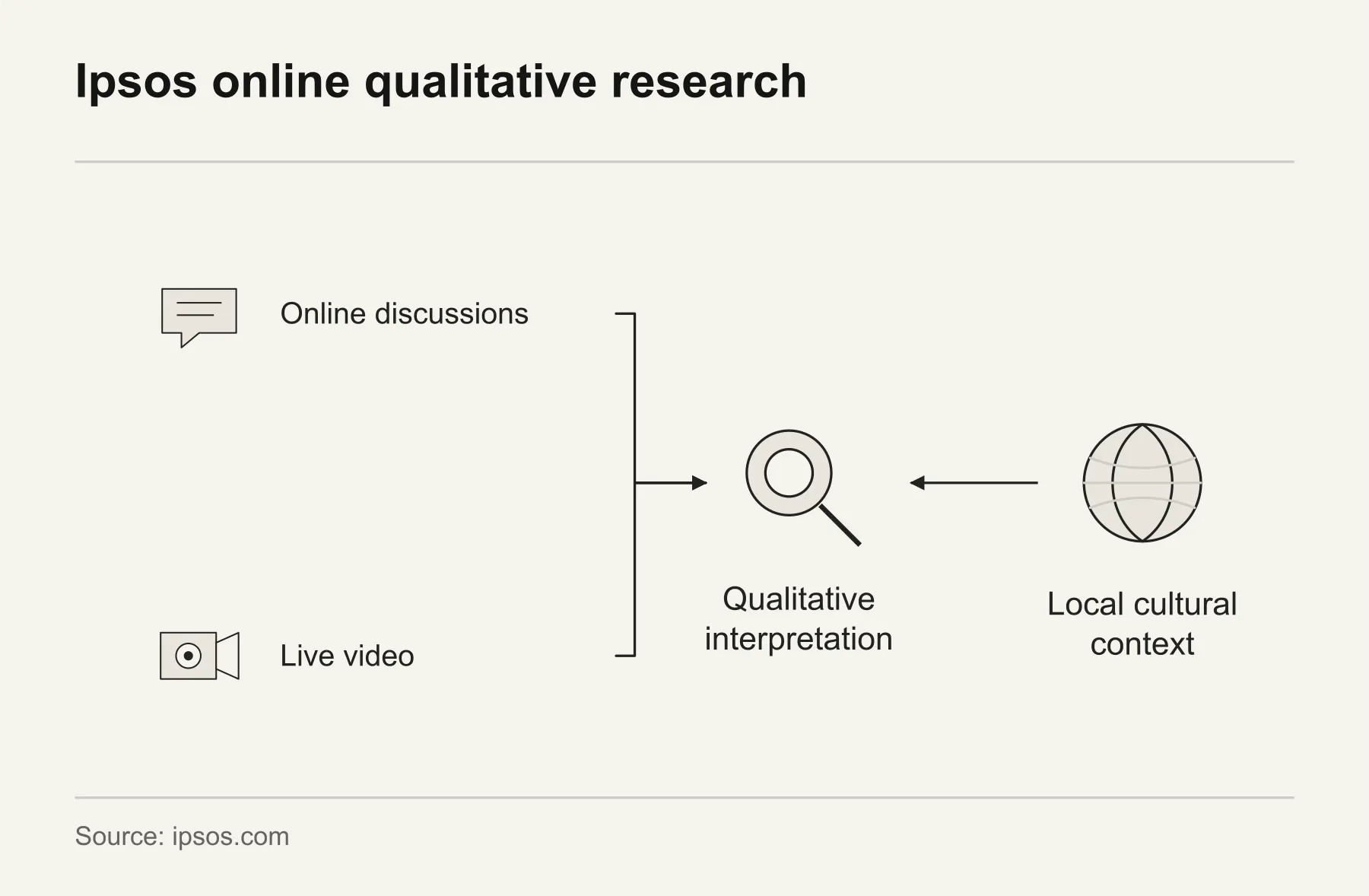
Ipsos’ online qualitative offer can bring participants from several markets into one study environment while local teams handle language and cultural context.
Ipsos fits high-stakes programs that need several methods, markets, languages, and senior stakeholders coordinated under one research lead.
Pricing is custom. Compare the proposed team, markets, methods, and senior analysis included in the fee.
Kantar: qualitative work within brand and innovation programs
Kantar offers ethnography, cultural insight, live qualitative research, online co-creation, and workshops. Its Converser product adds AI-moderated interviews with real participants. Kantar connects qualitative evidence to brand, creative, innovation, segmentation, and customer-strategy work.
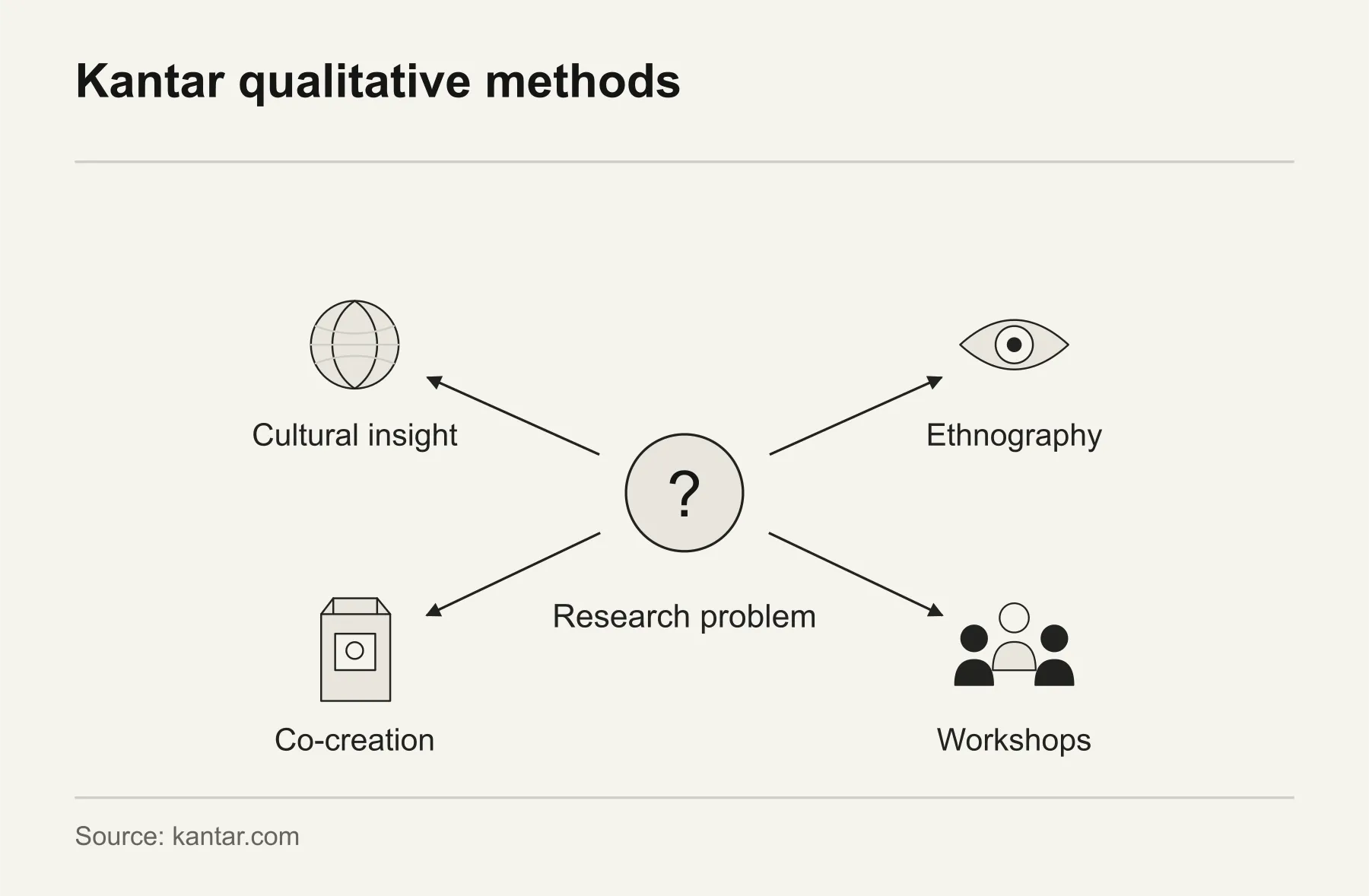
Kantar’s qualitative practice spans live research, cultural analysis, co-creation, and workshops.
Choose Kantar when the interviews need to feed a larger brand, creative, or innovation program. Its value is in connecting the conversation to the research and decisions already underway.
Pricing is custom. Confirm the markets, research methods, consulting support, and access to underlying evidence.
Communities preserve a relationship across questions
Use a continuing community when a later question depends on the same participant’s earlier experience. Returning to people as products and routines change preserves that history; recurring questions alone don’t require the same members.
Human8: managed communities and continuing feedback
Human8 manages online groups of people from your target audience. A short project can run for several weeks or months as you explore and refine an idea. A longer program lets your team return with questions as needs and products change.
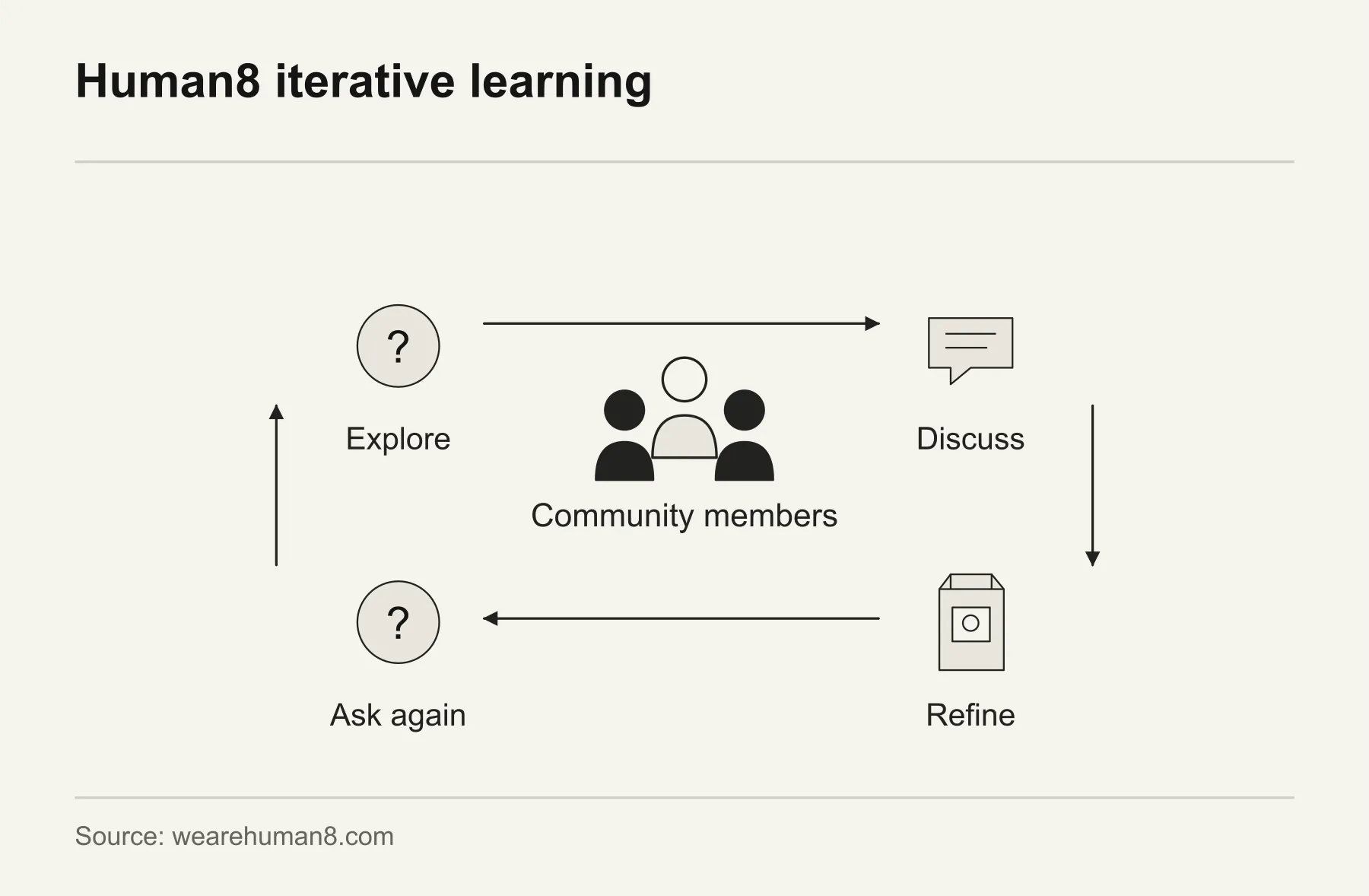
Human8’s community platform brings participant activities and discussions into one workspace across desktop and mobile.
Shortlist Human8 when you want a managed community and continuing research program. Compare Recollective, covered below, when your internal researchers want the software to run live sessions, self-paced studies, or communities themselves.
Pricing is custom. Community size, duration, frequency of research, and analysis support shape the scope. If digital twins are included, ask which findings come from members and which come from simulation.
Returning to the same members builds context. Keep their participation and exposure histories beside later findings; those answers aren’t fresh first-contact reactions.
Senior researchers can follow an unexpected answer
Bixa Research: senior moderation and manual synthesis
Bixa Research runs in-depth interviews, focus groups, UX and usability studies, video diaries, and ethnography. The firm says senior moderators conduct the work and the team analyzes the material manually. Deliverables connect themes to quotations or clips and a decision-focused recommendation.
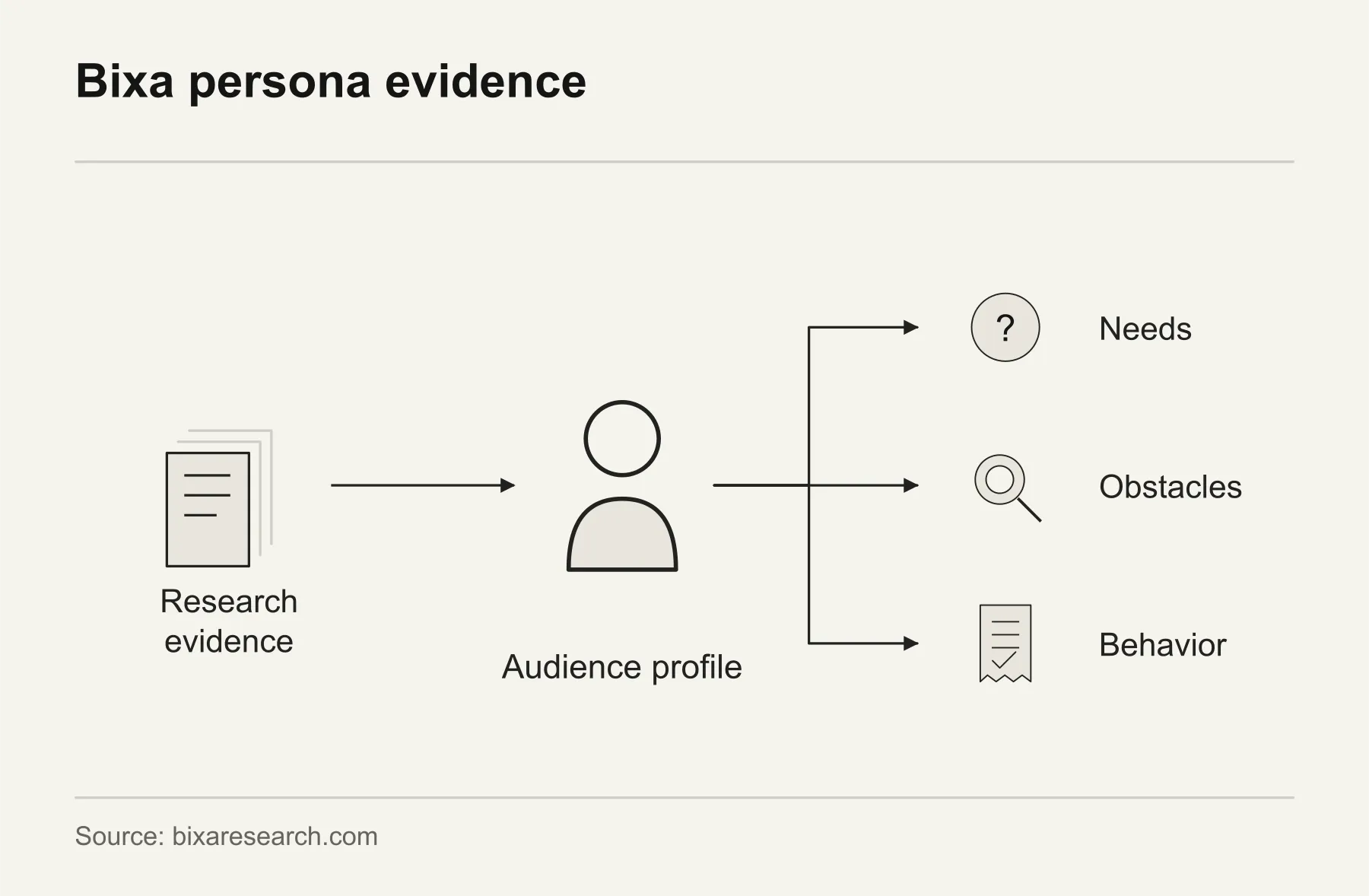
Bixa’s persona deliverable turns interview and survey evidence into audience needs, pain points, purchase behavior, and a decision-ready profile.
In a custom study, an unexpected answer changes the next question. Bixa keeps senior researchers involved in both the interviews and the interpretation, so that line of inquiry carries through to the recommendation.
Pricing and timing are custom. Confirm the audience, senior researcher involvement, and analysis and revision rounds included in the study.
Recruitment and facilities shape what can be observed
Compare qualitative recruitment services on the audience you need, how participants are screened and verified, and what happens if someone drops out. Confirm incentives, replacement terms and whether moderation and analysis are included. For in-person work, compare Sago when fieldwork spans markets and Fieldwork when a U.S. facility, prototype or physical setting shapes what you need to observe.
Sago: recruitment and fieldwork across markets
Sago supports groups, in-depth interviews, ethnography, product and sensory work, simulations, offsite studies, transcription, remote moderation, and international coordination. A global project manager can coordinate recruitment and data collection across markets.
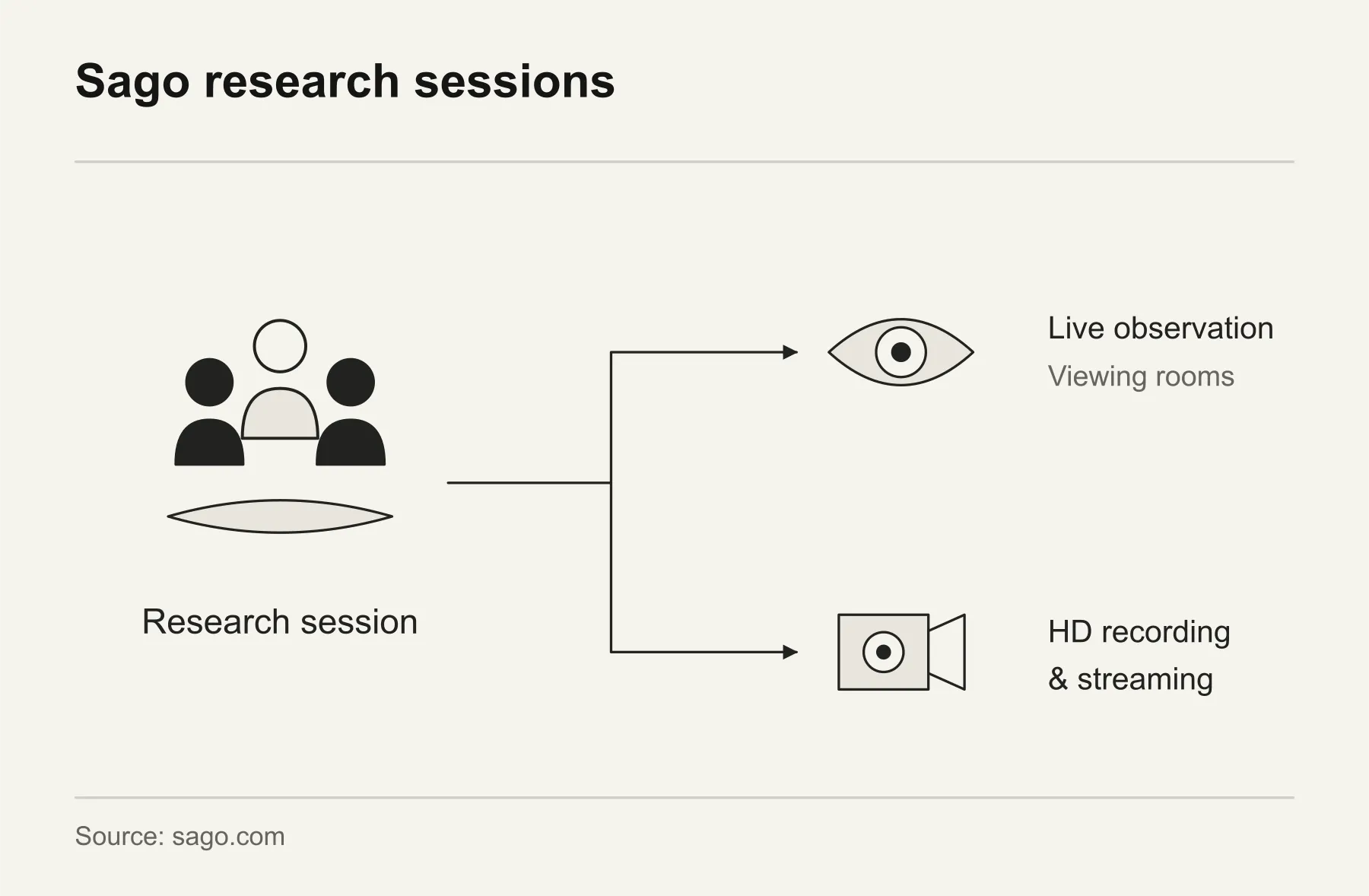
Sago’s New York facility page describes observation and recording infrastructure to confirm for facility-based research.
Sago makes sense when research requires participant sourcing, facilities, product handling, specialist setup, or consistent fieldwork across countries.
Pricing is custom. Recruitment difficulty, incentives, markets, facilities, product handling, translation, and project management shape the fee. Agree rescreening, replacement, and cancellation terms before fieldwork begins.
For a complete study, scope discussion-guide design, moderation, and analysis alongside fieldwork.
Fieldwork: US facilities and specialist research settings
Fieldwork combines research facilities, virtual sessions, recruitment, and project management, with specialist environments for usability, mock-jury, and medical-device studies.
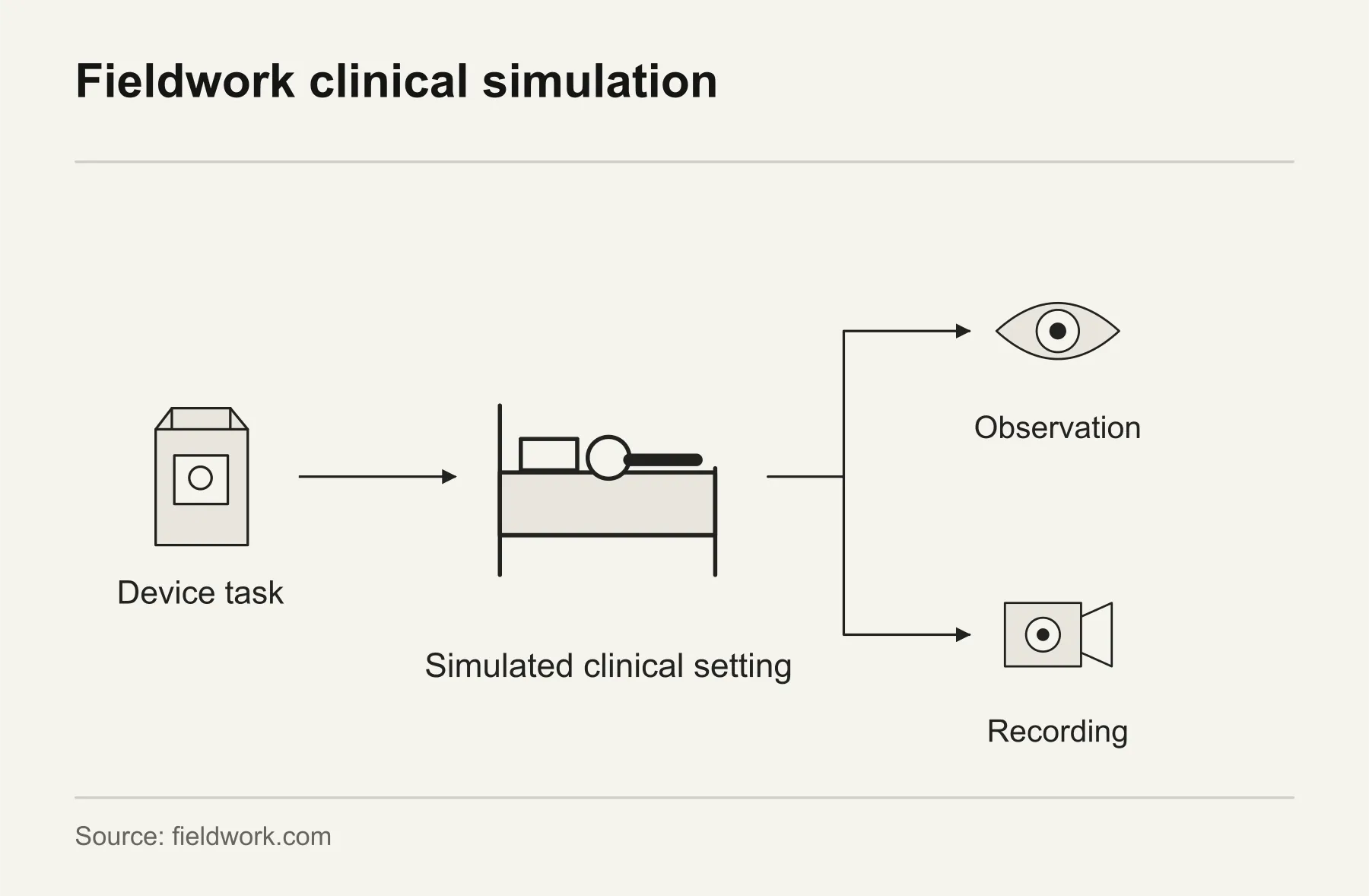
Fieldwork’s Dallas medical simulation center recreates a controlled clinical setting with observation infrastructure.
Fieldwork is useful when prototypes, NDAs, devices, simulation, observation, recording, or the physical environment affect research quality.
Pricing is custom. Confirm participant recruitment, facility requirements, product handling, and replacement costs.
B2B and healthcare audiences: expertise is not interchangeable
For hospital procurement leads, cybersecurity architects or physicians in narrow specialties, ask how the provider verifies the required role and recent experience. Broad consumer reach alone doesn’t show that it can recruit that audience.
NewtonX: specialist professional audiences
NewtonX describes specialist B2B recruitment by role, industry, seniority and domain expertise, with search across 140+ industries. Confirm strategy, screening, guide design, moderation, transcription, translation, synthesis and reporting in the proposed engagement.
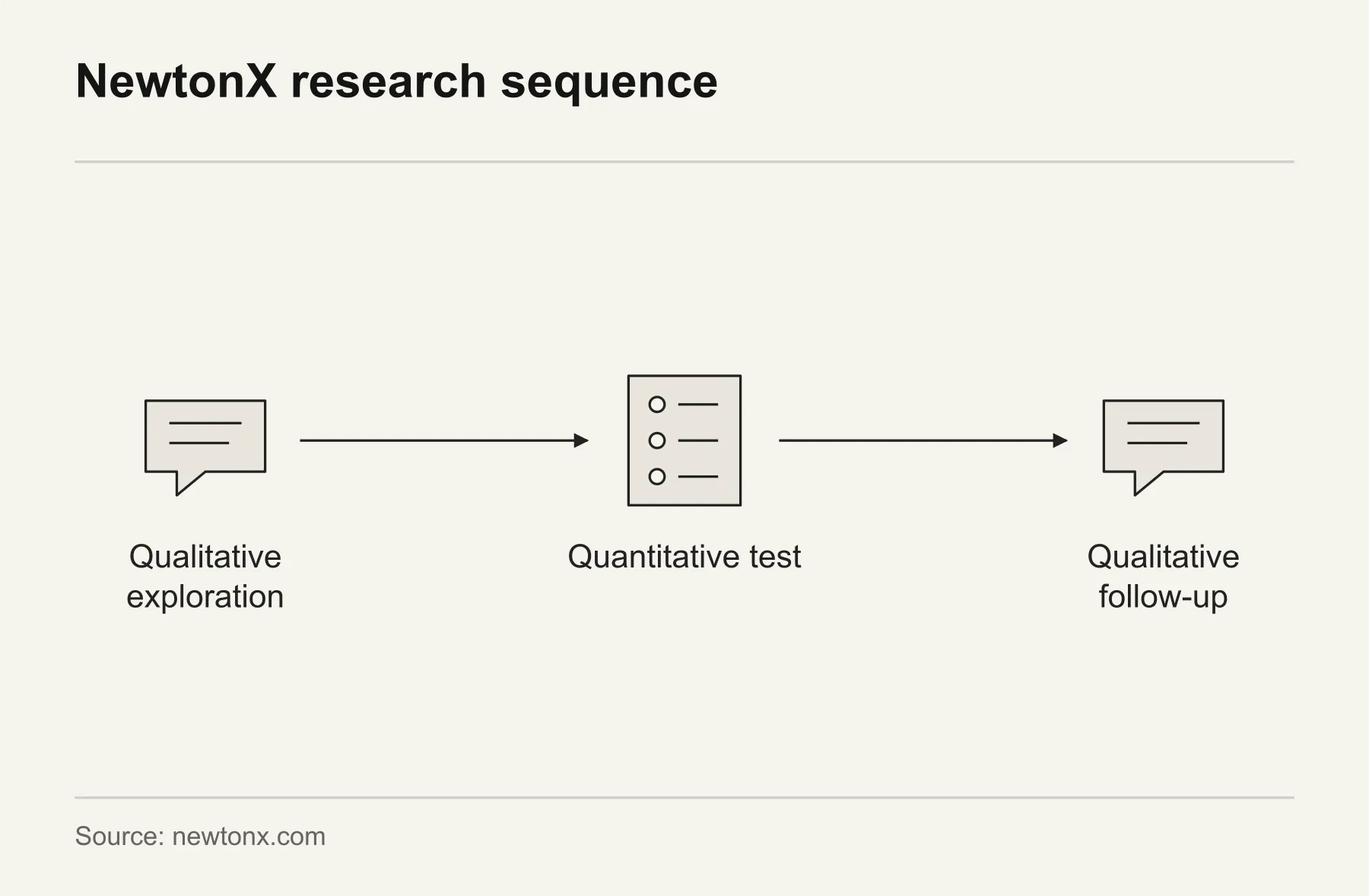
NewtonX’s Pinterest case maps a qualitative–quantitative–qualitative sequence for a hard-to-reach professional audience.
NewtonX fits studies where the participant’s exact role and recent experience determine whether their answers are useful.
Pricing is custom. The target role, qualification criteria, markets, and service level determine the scope.
M3 Global Research: healthcare recruitment and fieldwork
M3 Global Research combines healthcare-panel recruitment with remote and in-person methods, moderator selection, scheduling, facilities, and its QualStage technology. Its homepage describes a verified healthcare-professional panel and partner fieldwork in more than 70 markets. Confirm the available eligible audience for the required specialty and country.
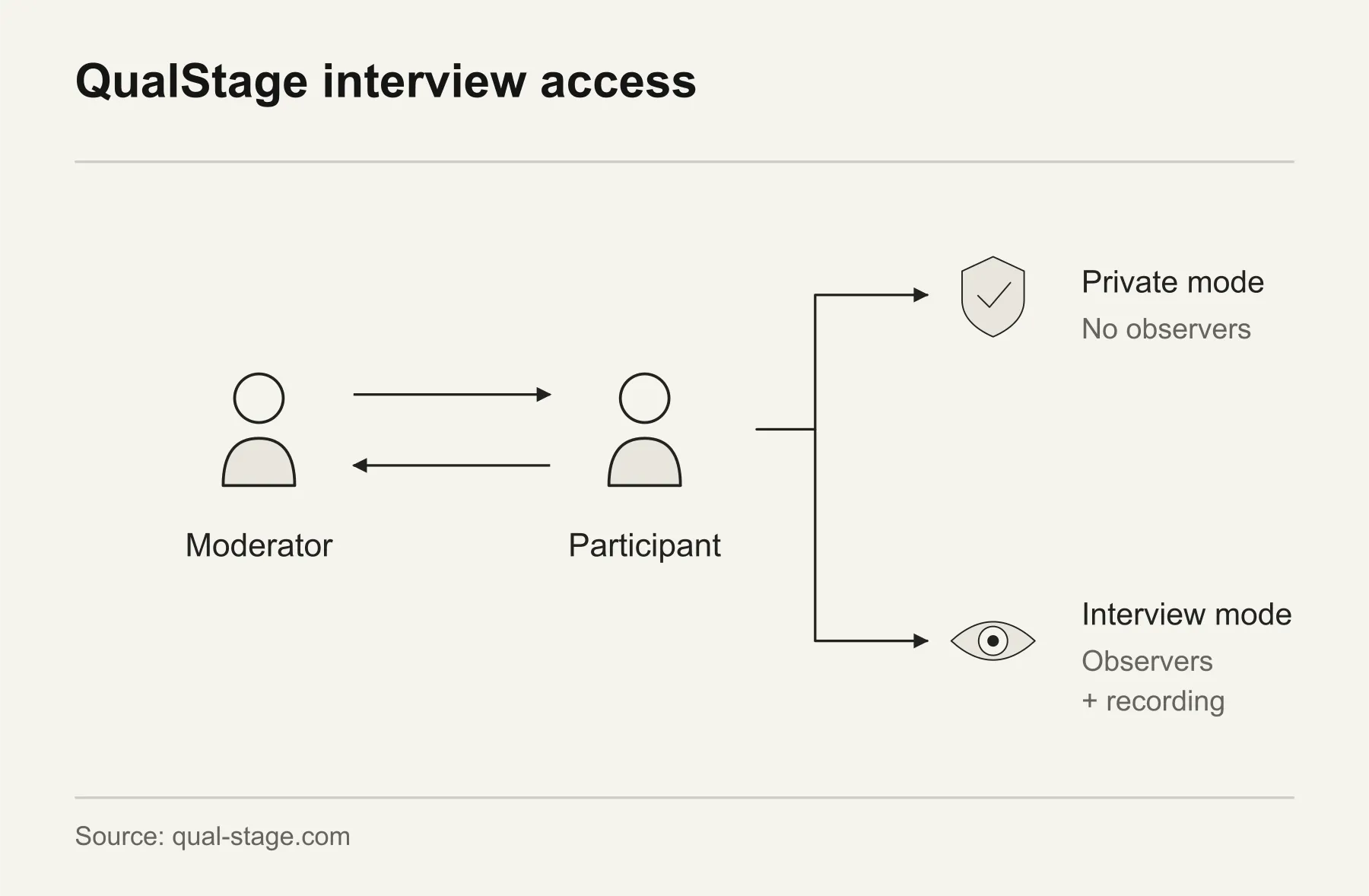
QualStage’s moderator view supports remote sessions where privacy, observation, and research controls matter, including healthcare work.
M3 fits healthcare studies where specialty, identity, consent, jurisdiction, and local operating rules shape recruitment and fieldwork.
Pricing is custom. Confirm participant source, credential verification, patient and caregiver coverage, adverse-event processes, moderation, translation, analysis, and reporting.
Software leaves research ownership with your team
Recollective: live sessions, self-paced work and communities
Recollective combines bulletin boards, diaries, ethnography, concept tests, live video, communities, AI moderation, translation, transcription, and AI-assisted analysis. Researchers can combine live sessions with activities participants complete in their own time.
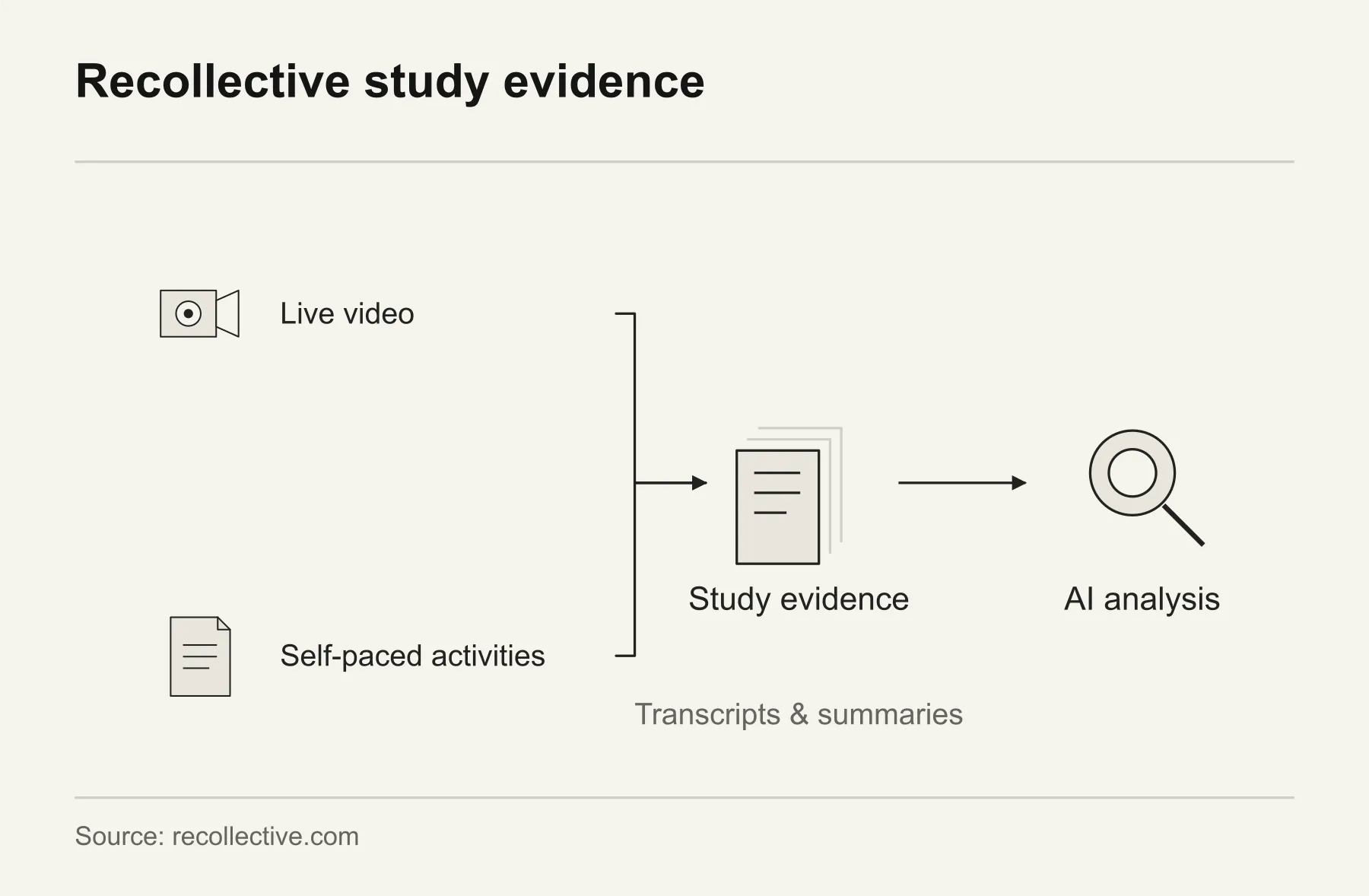
Recollective combines participant discussion with AI-assisted analysis in the same qualitative workspace.
Choose Recollective when your researchers lead the study and need one place to run the work. Live sessions, diaries, self-paced tasks, and ongoing communities sit in the same workspace.
Recollective lists annual licenses from $475 per month for Live Only, $750 for Qual Live + Async, and $1,250 for Connect communities. The $750 example covers 10 participants with an annual commitment. Project pricing is also available; compare video minutes, participants and open studies, and confirm recruitment and incentives in the quote.
Without added services, the buyer owns the question, participant source, moderation, analysis, and recommendation.
AI interview platforms collect responses from people
Start with Outset when you want close control over the interview guide and follow-up questions, Listen Labs for recruitment through reporting in one workflow, or GetWhy for video studies with self-service or managed support. Compare the interview flow and how each report traces findings to participants’ answers.
Outset: adaptive interviews controlled through the guide
Outset runs adaptive text, voice, and video interviews. Researchers can import a guide, configure probes and logic, show stimuli, use screen sharing, and capture text, voice, video, or voice-to-voice responses. Outset advertises more than 40 languages and 25+ panel integrations. Outputs include recordings, transcripts, reports, reels, and standard exports.
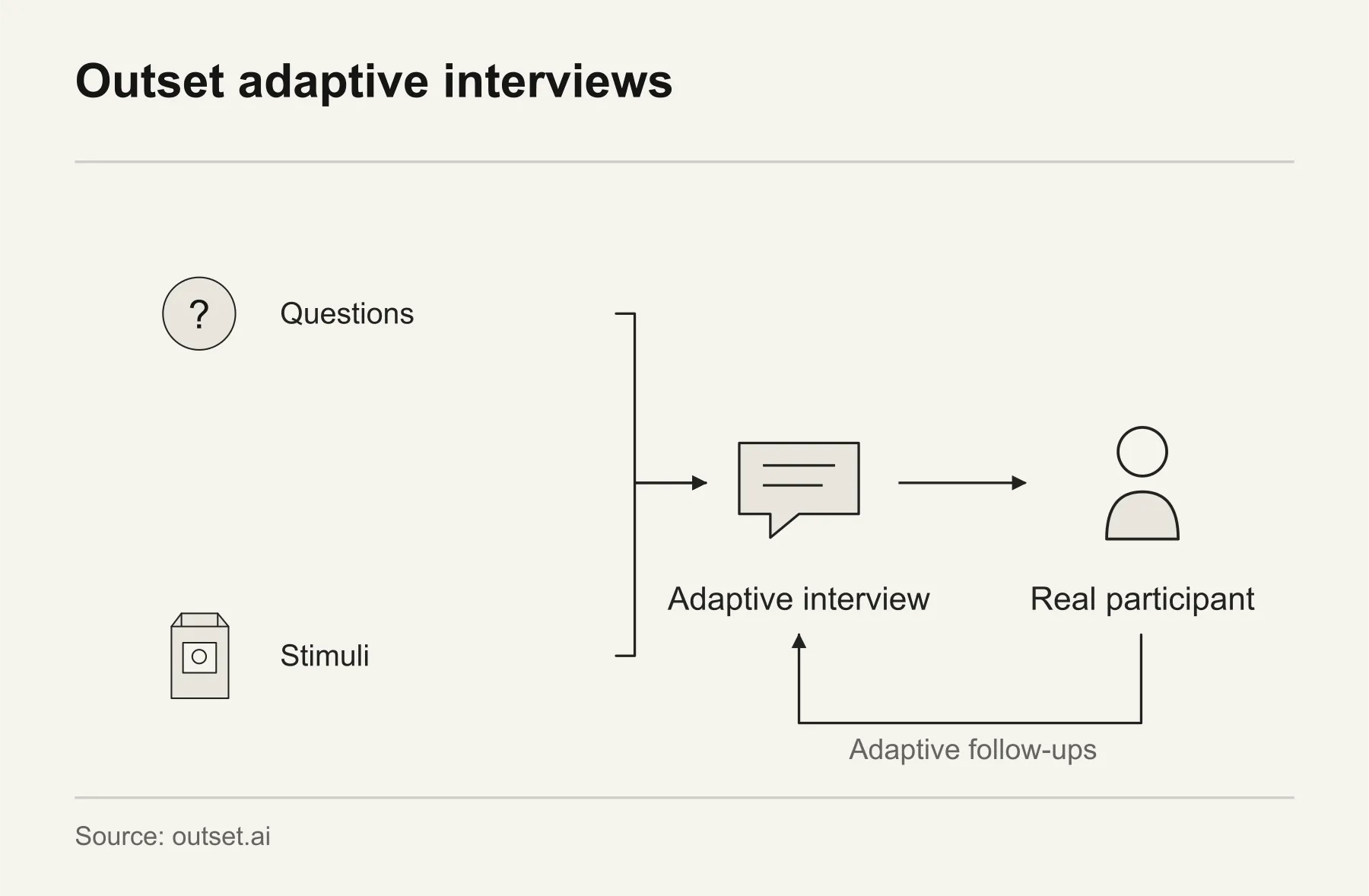
Outset’s guide editor shows how researchers configure questions and stimuli before AI-moderated interviews with recruited participants.
Outset suits teams that want to run more interviews while keeping control of the questions, the material participants see, and the source material behind each finding.
To compare these interviews with a modeled population study, our Vensia vs Outset guide also covers Outset’s person-linked Digital Twins. It explains how the audience, initial work and meaning of follow-up change the study you need.
Contact sales for pricing. Compare interview volume, recruitment, language coverage and research support.
Listen Labs: recruitment through reporting
Listen Labs drafts or imports guides, recruits from its network or an owned list, runs adaptive interviews, and produces recordings, reels, reports, and slides linked to source interviews. It advertises support for 120+ languages.
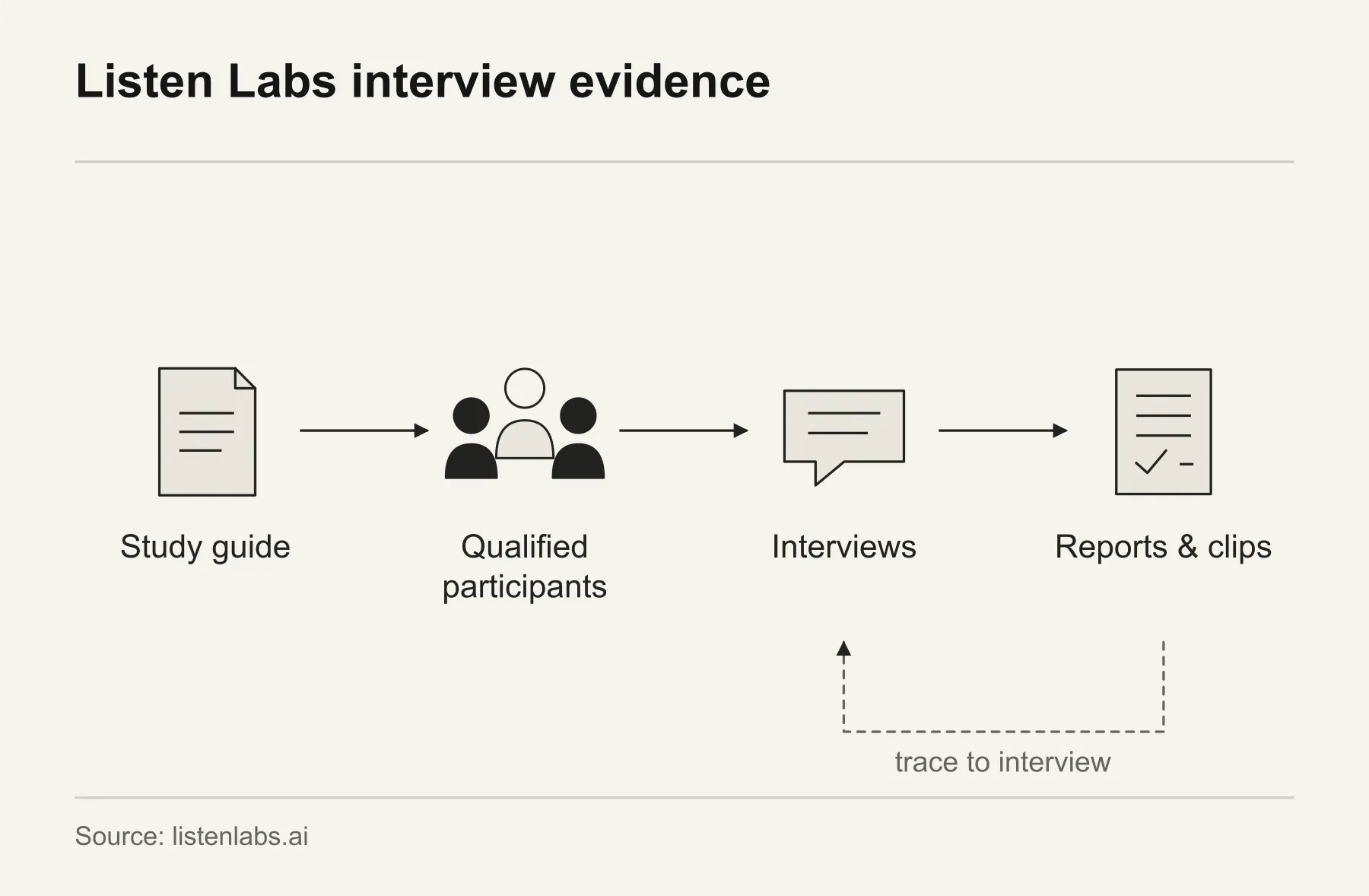
Listen Labs’ report screen connects a large interview study to generated deliverables and respondent-level detail.
A Microsoft case study reports more than 150 multilingual interviews and a 24-hour turnaround for that program.
Contact Listen Labs for pricing. Confirm recruitment, interview volume, deliverables, and any annual commitment.
GetWhy: video interviews with researcher review
GetWhy combines AI-moderated video interviews, automated coding and senior-researcher synthesis. Its advertised 48-hour delivery starts with the first interview, after study design and recruitment.
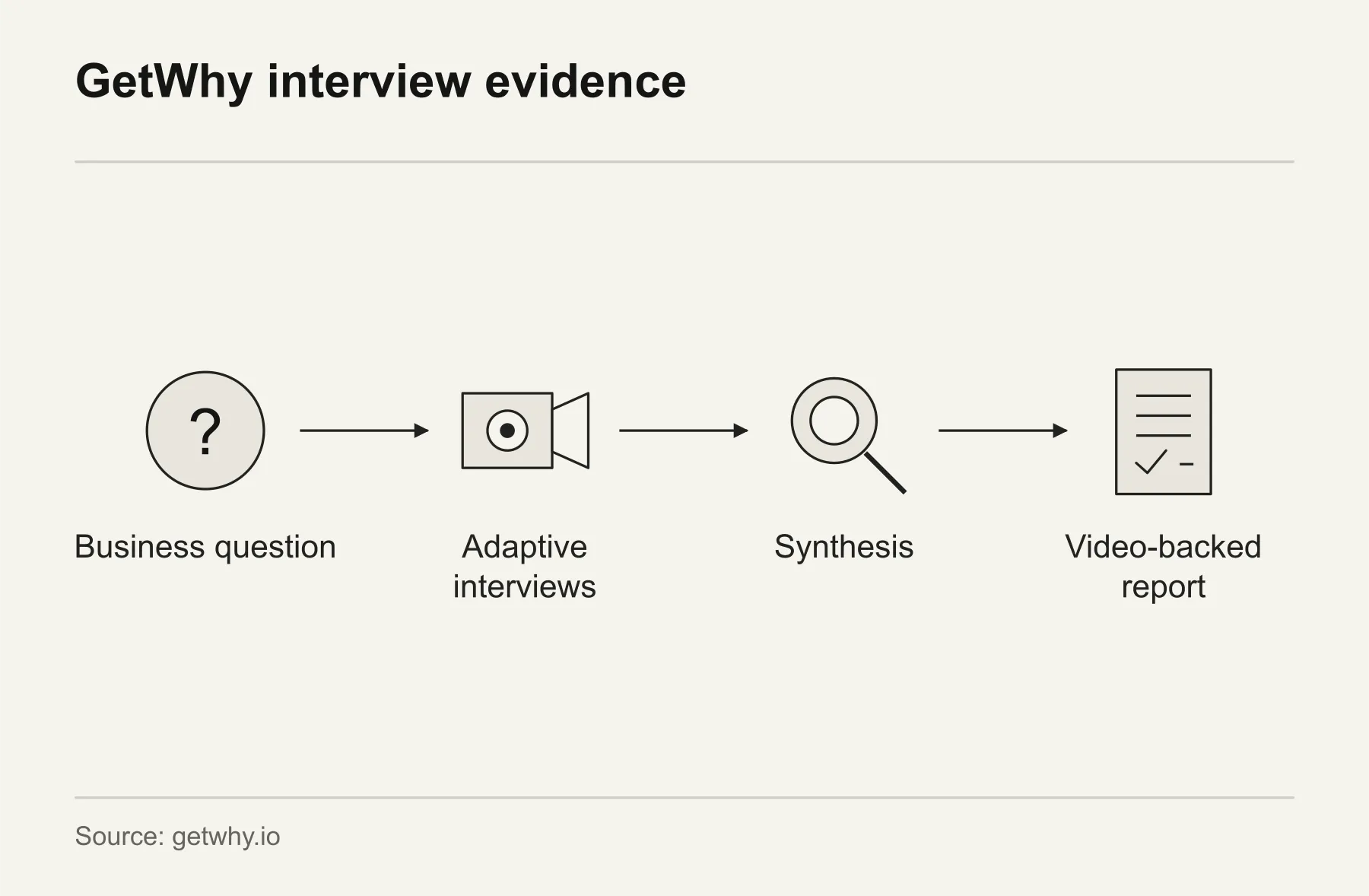
GetWhy turns a campaign brief and stimulus into an AI-moderated video discussion guide.
Compare GetWhy when your team needs video-backed findings and researcher review. Confirm who reviews the study design, monitors interviews and validates the synthesis in the proposed engagement.
GetWhy says first studies start at $2,000–$4,000 without an annual commitment. Confirm the audience, markets, and research support included.
For a wider comparison of automation, analysis, simulation, and research workflows, see our AI market research tools guide.
A modeled explanation needs measurable context
Vensia: modeled interviews with measurable context
Vensia is an AI-powered consumer and market research platform that builds data-grounded synthetic populations for the audience behind a decision. Each population contains thousands of distinct agents grounded in real purchase, behavioral, demographic, survey and market evidence.
Vensia runs qualitative interviews and synthetic focus groups with data-grounded agents to explore motivations, objections and trade-offs. Teams can get modeled answers without recruiting, scheduling or incentivizing a human panel, making early exploration practical when the target audience is difficult or slow to assemble.
- Full transcripts, respondent context and automated theme synthesis show how each finding relates to the audience.
- Surveys, segment comparisons and tests of ads, creative, concepts, claims and prices connect qualitative explanation to measured response and behavioral prediction.
- Findings and recommendations arrive on a schedule agreed for your study. Return to the same population when new questions arise.
A modeled interview, with the reason behind the choice
Vensia recreated early FSA/Ipsos interviews about ordering food online with 40 synthetic participants: 20 in England and 20 in Northern Ireland. One modeled 29-year-old respondent in England said hygiene mattered but was not the first thing he checked while hungry and scrolling. Later, he explained: “For my normal online orders I tend to rely on the app reviews and familiarity, partly because the hygiene rating isn’t put in front of me there.”
The account points to a testable question: will making the official rating visible beside an outlet change the choice? In a comparison with six published human-study findings, two reviewers each found five specific matches in Vensia’s interviews (83.3%); they agreed on the same four. Those are finding matches, not the share of people who think this way.
Inspect our interview comparison
The FSA/Ipsos recreation compares simulated interviews with published human findings. It helps you inspect agreement for that interview task; it doesn’t establish future ordering behavior. Ask for validation matched to the audience and decision you plan to use. As the audience or market changes, update the population’s supporting evidence.
Separate the source of an answer from the way it was collected. A human moderator and an AI moderator can both interview recruited people. A conversation with a Vensia agent produces a modeled response. Ask to inspect the transcript, the audience context, the follow-up and the evidence supporting the interpretation. A vivid quotation alone does not show how common the explanation is.
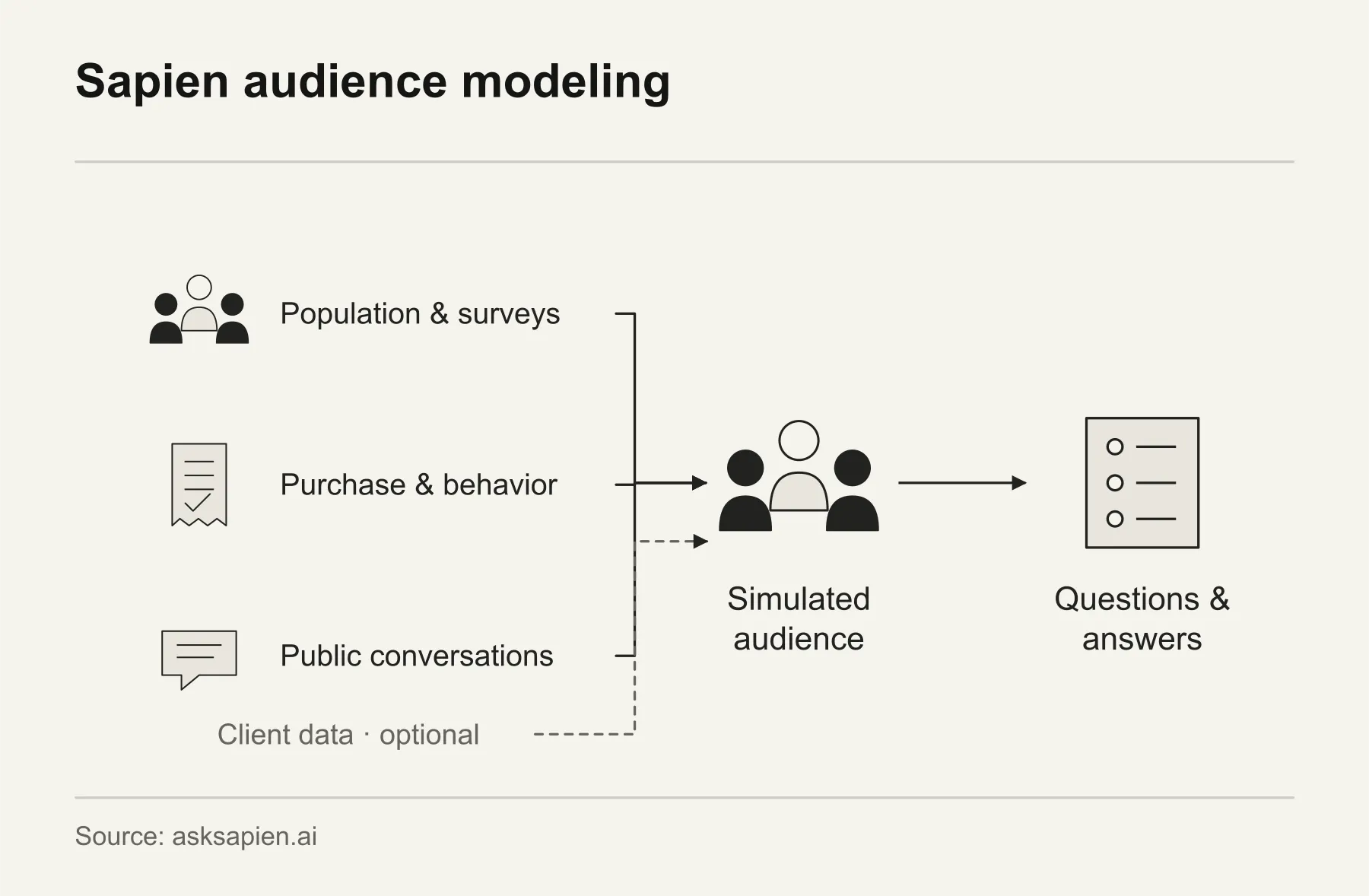
Vensia grounds its populations in real-world population, purchase, behavioral, survey, and market evidence.
Which qualitative method fits your question?
Choose in-depth interviews when you need to follow one person’s experience, investigate a complicated decision or discuss a topic privately. The moderator can pursue an unexpected answer without another participant setting the direction.
Use focus groups when the interaction matters: how people describe a concept, challenge a claim or build on one another’s ideas. That discussion can help your team improve the proposition and language. Our focus group research guide shows how to capture what the conversation adds to each person’s first reaction.
Choose observation or ethnography when the question concerns what happens in context, such as shopping for a product or using it at home. Seeing the setting, routine and workarounds can reveal a problem an interview leaves unexplained. Ask the shortlisted firm to connect its proposed method to the decision you need to make.
Human interviews, AI moderation or synthetic focus groups?
For physical product use, recruit relevant people and choose a setting where researchers can observe what happens. A simulated response cannot establish how a prototype feels, fits or works in someone’s hands.
When comparing qualitative research service providers for online studies, ask who recruits and screens participants, how moderators follow up, and which transcripts or recordings you can inspect. Confirm who develops the themes and recommendations. In AI-moderated human interviews, software asks questions and collects answers from people; check what a researcher reviews before the findings reach your team.
Vensia uses data-grounded synthetic populations for complete qualitative and quantitative studies: investigate motivations, compare segments, test alternatives and predict response. Its interviews are modeled responses. Direct observation of physical product use calls for participants and a suitable research setting.
For the conversation design, use our AI focus groups guide. To choose the evidence source, our synthetic vs human respondents guide explains when modeled comparisons fit and when participant evidence is needed.
A useful report shows why the recommendation follows
Ask the shortlisted provider to show how one recommendation follows from the underlying interviews or modeled responses, including disagreement and unanswered questions. For a modeled audience study, Vensia’s team builds the population, runs the research and delivers findings with the individual answers behind them. Review a sample report for the kind of customer choice you need to understand.
For service options, see our market research services. For the wider provider market, continue to our market research companies guide.