
Vensia vs Simile: Choosing What to Test Next
A renewal-email decision shows how to separate preference from comprehension and use uncertain findings to focus the next research step.
Compare Vensia and Simile on how a study handles comprehension and uncertainty alongside preference. In a broadband renewal email, customers need to understand the price and commitment before you advance a message. Vensia offers a managed audience study with segment comparisons, underlying responses and follow-up questions.
Simile also models responses to change, with human-grounded populations and a published approach to predicting the error of each result. The useful distinction is how the engagement helps you separate a promising direction from a question that still needs direct customer research.
What each approach gives you to evaluate
Simile describes populations grounded in real people, using behavioral information, studies and interviews. Customers can also bring their own data. Its scope includes customers, employees and broader populations, with comparisons of how the same population responds when a situation changes.
Simile's confidence methodology describes a model that predicts the error of a simulation result. Here, error means the gap between simulated and human or observed answer distributions, measured using total variation distance. This concerns the distribution of answers across a population, not the probability that a particular person's answer will be correct. Simile trains on comparisons between simulated and real responses, and surfaces a predicted error for a new question. That is more specific than one average accuracy figure for the whole product. The estimate still needs evaluation for the task where you intend to use it.
At Vensia, our team grounds a simulated audience in relevant purchase, behavioral, demographic and research information. We run surveys, qualitative interviews and comparison tests, then provide an interactive report with segment results, recommendations and follow-up questions. Our audience-building guide explains how the decision and source coverage shape the study.
Dimension | Documented offerings |
|---|---|
Audience foundation | Vensia: Relevant consumer and research information; optional customer context Simile: Human studies and behavioral data; optional customer data |
Research interaction | Vensia: Team-run study, interactive report and follow-up questions Simile: Population simulations across scenarios; confirm the workflow in your engagement |
Uncertainty evidence | Vensia: Task-specific benchmark comparisons; agree study-specific reporting Simile: Published methodology for predicting error on individual simulation results |
Commercial scope | Vensia: Request study deliverables, timing, responsibilities and fee Simile: Request access, support, customization, timing and fee |
The offerings overlap. Request the study, access, support, customization and full fee in a proposal based on the same brief.
Make uncertainty change the research plan
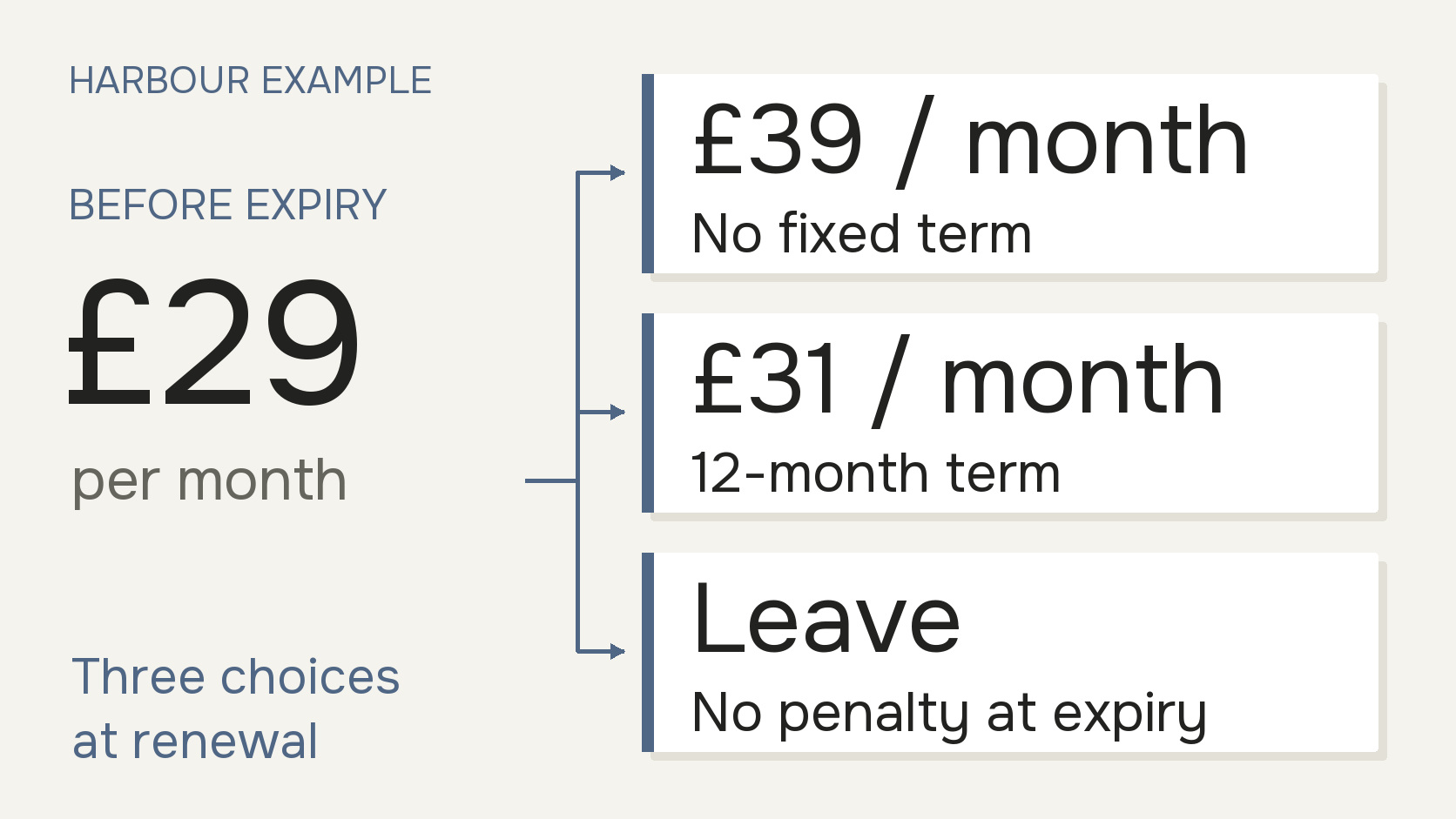
Consider Harbour, a fictional broadband provider deciding how to explain a renewal offer. Its UK customers paid £29 per month on a twelve-month contract. At expiry, they can move to £39 per month without a new fixed term, renew for twelve months at £31, or leave without an end-of-term penalty.
The team has two email approaches. One leads with the renewal price. The other leads with the customer's three choices. Both must show the same terms. The decision is which version to develop and test with customers, with comprehension and sense of control treated as requirements alongside stated preference.
A generic population of broadband users could conceal the differences Harbour needs to understand. Customers approaching expiry for the first time may have different questions from experienced switchers. People who cannot access another provider may respond differently from those with several options. The brief should ask what evidence covers those situations and when it was collected.
Set a comprehension gate before picking an email
Harbour should judge each explanation against three fixed facts: the price after expiry, the commitment required to pay £31, and the right to leave at the end of the current term. Agree those checks before comparing which email is preferred. A version should not advance solely because it is liked if the explanations reveal confusion about a material term.
In Vensia, the team can compare the versions within relevant groups and inspect where the reasoning changes. If one group mistakes the twelve-month renewal for a rolling plan, a follow-up can explore the wording behind that interpretation. The next action is to repair and test that explanation, rather than treat an overall preference score as permission to roll out.
When source coverage or the modeled result leaves the commitment unclear, direct customer research can focus on that uncertainty. Harbour can then take a revised candidate into a comprehension test and measure switching or renewals separately. A confident-sounding simulated explanation is not itself a confidence measure.
Simile’s Itaú case connects simulation with targeted human research
In Simile's account of work with Itaú, the bank used simulated customer archetypes to explore hypotheses about a recurring-payments experience. The article describes simulation early in development, followed by direct human research focused on greater uncertainty or risk. It is a vendor-authored customer case, rather than an independent audit of every simulation.
That sequence is useful for Harbour: explore alternatives while they are easy to change, identify the questions still open, and direct human research toward those questions. The case's reported timing is specific to that engagement. It does not establish the turnaround of your project or the accuracy of a broadband renewal model.
Ask Simile to explain how its confidence estimates are calibrated for populations and questions like yours. Its methodology describes held-out evaluations, where the scoring questions were excluded from training. Ask to see where predicted error was too optimistic as well as where it tracked actual error well.
Our synthetic-user evidence page shows why exceptions deserve inspection. In a comparison of eight 2025 Ad Meter spots, Vensia’s average score error was about 0.14 points on a five-point scale, and both series put Budweiser first. But Uber Eats scored 2.92 and ranked fifth in Vensia, versus 3.38 and second in the human results, a 0.46-point miss. That supports investigating a shortlist and its anomalies. It does not establish that ad liking predicts sales. These are Vensia-authored comparisons, not a matched test against Simile.
Harbour’s next test should resolve the renewal terms
Evaluate Simile if its behavioral model, scenario workflow and predicted-error approach fit your program. Ask who configures the model, runs the study, interprets the output and handles updates. If population-level price or demand evidence is your main concern, our Vensia vs Aaru guide works through that decision.
Give each provider both complete emails and the three term checks: the expiry price, the commitment needed for the renewal price and the right to leave. Our research brief template can record those checks and the buyer groups. Use a Vensia introduction to scope the comparison and which uncertainty the next customer test must resolve.