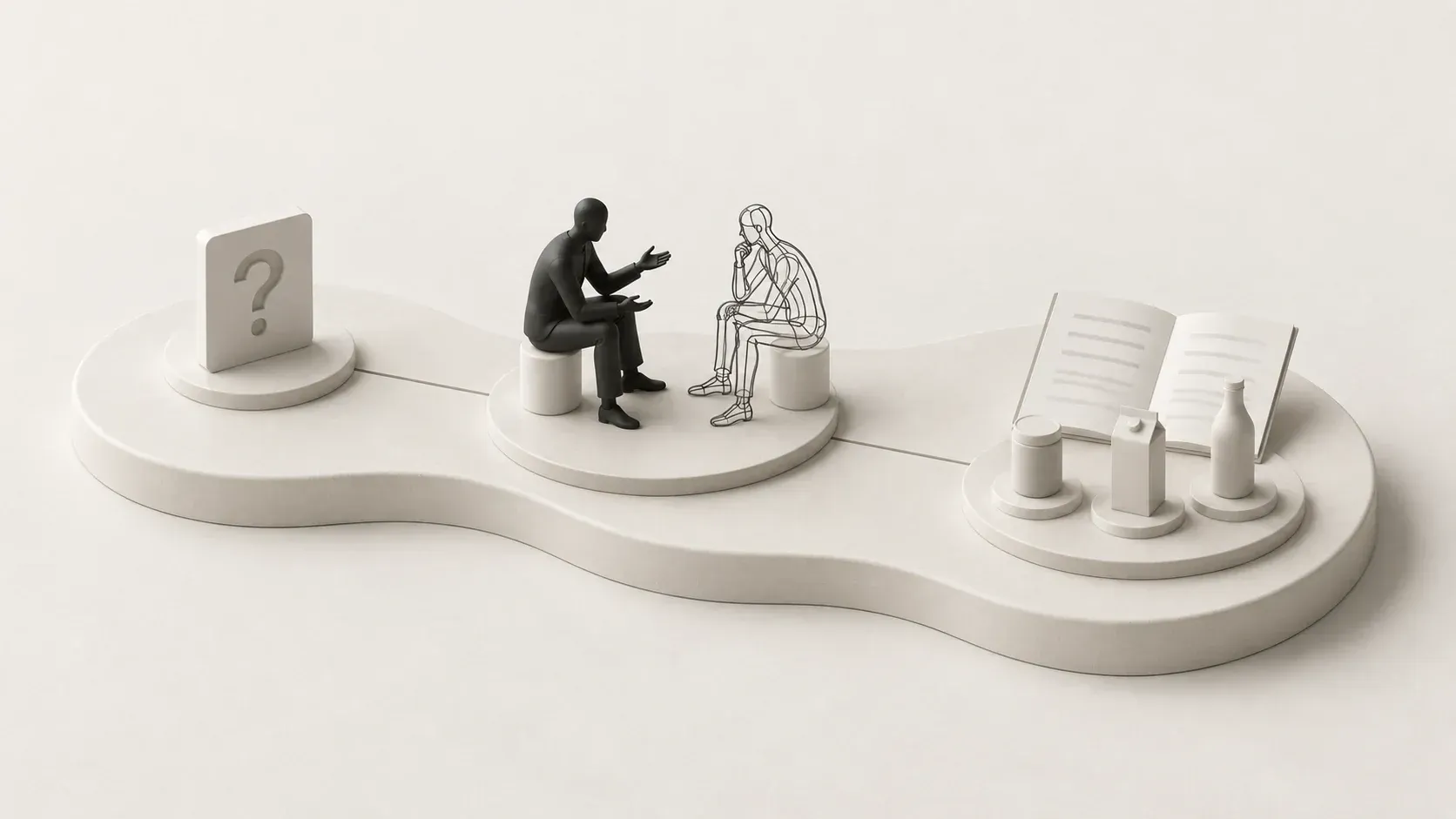
Concept testing companies: choose the research support you need
A breakfast-pot and family-kit example shows how to compare providers on design, audience, interpretation and follow-up responsibility.

Choose a concept-testing company by the research work your team needs it to own. A food brand choosing between a single-serve breakfast pot and a family-size kit needs to know whether buyers understand the preparation and which offer deserves a prototype. Compare providers against that same decision, including who will investigate misunderstandings and run the next comparison.
The breakfast brief makes responsibility visible
In this illustrative brief, the buyer’s breakfast occasion and preparation needs should shape the prototype choice. Ask each provider how its research will connect those needs to appeal, feasibility and the next investment, including any preparation or value barrier to resolve first.
What the partner owns and what your team supplies
Use the responsibility map to see which work the provider accepts and which inputs your team still owns.
Work | Partner responsibility and brand input |
|---|---|
Design | Managed partner should agree: Instrument, assignment, quality checks and analysis plan Your team must supply or approve: Decision, feasible cards and progression criteria |
Audience / grounding | Managed partner should agree: Human recruitment or modeled-population construction, with evidence status Your team must supply or approve: Market, eligibility and shareable category evidence |
Interpretation | Managed partner should agree: Source-to-finding-to-recommendation walkthrough, including contradictory cases Your team must supply or approve: Commercial constraints and actual product facts |
Iteration | Managed partner should agree: What revisions and follow-up comparisons are included Your team must supply or approve: Which improved concepts are ready to compare |
Acceptance | Managed partner should agree: Saved stimuli, instrument, segment bases and assumptions in agreed format Your team must supply or approve: Confirmation that the result answers the brief |
Both cards should state occasion, contents, preparation, pack size, proposed price and comparable image detail. Include what eligible buyers currently use when the task concerns switching. Beating an implausible alternative can produce a winner with little practical meaning. Keep name-only reactions separate from reactions to the complete breakfast offer.
Agree what would justify advancing an offer before fieldwork. Understanding, feasibility and sufficient appeal under the team’s economics belong together. A universal launch cutoff cannot replace those conditions, and a forecast needs explicit launch assumptions.
Five providers offer different kinds of support
Provider | Research job to discuss first |
|---|---|
Decision Analyst | A bespoke instrument and researcher-led interpretation for the concept decision. |
Zappi | A repeatable testing program with the tailored audience or professional services your team needs. |
Kantar ConceptEvaluate | Standardized diagnostics with an agreed serviced setup and researcher readout. |
NIQ BASES | Concept optimization in portfolio and reference context, with launch assumptions made explicit. |
Ipsos InnoTest | Choice against the alternatives buyers currently use, with the assisted or self-service scope confirmed. |
Use this as a shortlist by research job. The provider sections below explain which design, audience, interpretation and iteration responsibilities still need agreement in the proposal.
Decision Analyst: bespoke design and interpretation
Decision Analyst offers researcher-led design and analytical consulting for a custom concept decision. Confirm audience, fieldwork, analysis and who resolves a preparation misunderstanding.
Zappi: a repeatable testing program
Zappi combines a platform with professional services for tailored standard solutions, custom audiences and program support. Separate license, sample, custom work and interpretation in the quote, and specify human or synthetic response sources.
Kantar ConceptEvaluate: standardized diagnostics with a serviced route
Kantar ConceptEvaluate offers study setup, a dashboard, written evaluation and a human researcher readout in its serviced scope. Self-serve and serviced arrangements differ: confirm diagnostic modules, audience, concepts and included iteration.
NIQ BASES: portfolio and reference context
NIQ BASES combines concept optimization, portfolio context and expert consulting with databases and predictive analytics. Check whether the category and launch conditions fit the reference evidence. A forecast still depends on its assumptions.
Ipsos InnoTest: choice against current alternatives
Ipsos InnoTest offers choice-based diagnostics, acceptor profiles and optional modules against the products or solutions consumers currently use. Assisted and self-service routes differ. Confirm design, recruitment, interpretation and the evidence behind a Trial Index before treating assisted access as a fully managed project.
Use these documented services to choose the research job to discuss, then confirm the exact audience, analysis, included follow-up and price in the proposal.
View an example study to inspect the audience, offer and findings before planning your own.
The missing responsibility sets the shortlist
If the two offers need a bespoke instrument or difficult interpretation, begin with a researcher-led proposal. If the team is building a recurring program, ask where platform services begin and end. If a standard diagnostic study fits, compare exactly which setup and readout are included. If portfolio or forecast implications drive the investment, ask which reference evidence and commercial assumptions support them.
Do not use the number of services on a website as a substitute for a written responsibility map. A license, purchased responses, assisted setup and full interpretation are different scope items. Zappi also advertises a separate synthetic screening route, so specify the response source used by the quoted solution.
The proposal should expose the unfinished work
Ask for an illustrative or redacted walkthrough that connects one unfavorable answer to an action. A polished score does not tell you who will resolve a preparation misunderstanding. Check who owns that question and whether the follow-up is included, rather than discovering a new purchase at the end.
A favorable family-kit score can hide the wrong experience
Suppose the family kit leads on interest, but unaided answers describe it as ready to eat. The intended product requires preparation. The card describes one experience while those answers concern another. Resolve that mismatch before using the score to prioritize a prototype.
Request the exact card, preparation question, coding rule and comprehension base. Check whether people who understood preparation reacted differently from those imagining immediate consumption. That grouping is a way to investigate the misunderstanding; because it is formed from the answers, it is not a new randomized test. Use it to explain the issue and define the comparison needed next.
Preparation can change the card or the product
First confirm that the card accurately and visibly states preparation. If the fact is missing, repair the card. If the complete offer has an unattractive preparation burden, the development team may need to revise the product or positioning rather than add persuasive copy. Those are different actions, so the report should identify which evidence supports each.
If the family-kit card is unclear, revise its preparation description and reassess understanding before relying on the original interest score. Keep the underlying product and other relevant facts fixed for that communication repair. If the product changes, save a new concept version and evaluate it as a new offer.
Vensia: a managed comparison before the prototype
Our managed research service compares the breakfast offers with simulated populations and helps your team interpret which buyers respond, why and what to change. Agree the audience evidence, task validation and recommendation the study must return. Use that comparison to narrow the prototype brief; physical preparation, taste and actual repeat purchase still need product or behavioral evidence.
The recommendation needs a working record
Retain the instrument, cards, exposure, eligible segment bases, exclusions, material assumptions and next action in the agreed format. Keep human and modeled response sources labeled. For a standardized diagnostic index, inspect what the index means and which reference evidence fits; do not rename it as actual purchase probability.
Our published foldable-iPhone report illustrates modeled qualification and switching. It is an example of a report, rather than observed product demand. Use any sample report to inspect the path from source to finding to recommendation and the evidence still required.
The same brief makes proposals comparable
Choose the first conversations around the hardest research task, using the same cards, responsibility map and advancement criteria. Request audience feasibility, response source, included follow-up and the complete price. Compare which partner will deliver the recommendation and reassessment at a scope and workload your team can support.
For the preparation-misunderstanding case, accept a provider that names the unresolved experience and owns a bounded reassessment. Ordering a broader survey without resolving that fact adds volume while leaving the prototype choice unfinished.
Further reading
- our name-testing guide
- our concept-testing guide
- our concept testing tools guide
- our guide to market research services and costs
- our synthetic versus human respondents guide
- our market research companies guide
For the family-kit decision, discuss a managed Vensia comparison that investigates preparation understanding and identifies what the prototype team should test next.