
Market Research Services: Types, Costs and How to Choose
Compare market research services by the decision, evidence source and who does the work. See scoped cost examples and what a complete study should return.

Before comparing quotes, write down the decision, the audience and what your team needs back: findings, an explanation and a recommended next step. Then check who owns study design, audience access, analysis and follow-up. Two proposals can promise a report while leaving very different amounts of work on your desk.
At Vensia, we run qualitative, quantitative and predictive audience studies using data-grounded synthetic populations, then connect modeled findings to a recommendation.
Compare services · See cost examples
What are market research services?
Market research services help businesses understand customers, competitors and markets through work such as study design, audience recruitment or population construction, data collection, analysis and recommendations. You can commission a complete study or buy a specific part of it, such as interviews, survey fieldwork, pricing analysis or a market report.
The first distinction to make is between what the research needs to answer and who will do the work. You can buy a pricing study as a fully managed engagement or run one yourself in software. Either way, the study still needs a suitable audience, realistic choices and someone who can explain what the results mean for the business. Confirm whether the audience includes prospective buyers and people who stopped buying, as well as current customers.
Which market research service do you need?
Use the decision in the left column to narrow the scope. Several methods may contribute to one study; agree on the final output before selecting them.
Your decision | Service and what to ask for |
|---|---|
Which opportunity should we pursue? | Service: Market analysis and custom research Ask for: Market definition, competing alternatives, demand evidence and a recommendation |
Who should we target? | Service: Customer research and segmentation Ask for: Distinct groups, their needs, how to reach them and what to offer |
Why are customers choosing, switching or leaving? | Service: Qualitative research and journey research Ask for: Motivations, barriers, decision points and specific changes to make |
Which idea or message should move forward? | Service: Concept, claims and creative testing Ask for: Comparative results, differences by audience and a revision brief |
What should we charge? | Service: Pricing and choice research Ask for: Response at the tested prices, switching patterns and the assumptions behind the recommendation |
What is happening in the market now? | Service: Brand tracking, retail measurement or ongoing research Ask for: Comparable measures over time, explanations of change and implications |
Does the product work in use? | Service: Usability, sensory or in-home product research Ask for: Observed experience with the actual product and the problems to fix |
For nonprofit teams, our nonprofit research services guide separates funder reporting, beneficiary program decisions and donor-message work. It shows how funding conditions can change the service and the first study to commission, and when adequate program evidence lets you choose a narrower appeal study.
Market analysis and custom market research
Market analysis establishes the landscape: who buys, what they spend, which alternatives compete and where demand may be underserved. Start with relevant existing evidence, including your sales data, customer research, public statistics and licensed industry reports.
Custom market research is designed around your particular question. A published category report may describe the coffee market; a custom study can examine whether a specific audience would choose your subscription at a particular price. The audience, questions and alternatives must fit that decision.
Ask for the market definition and assumptions behind any estimate. “Coffee drinkers” and “people who regularly buy specialty coffee online” are different markets. A large headline market size will not tell you how many customers you can realistically serve.
Customer research and segmentation
Consumer research services investigate what buyers need, how they choose and what might change their behavior. Segmentation turns those differences into groups a team can use for product, marketing or service decisions.
A useful segment does more than describe a person. It tells you why that group might choose you, what would stop them and how to reach them. “Convenience matters” becomes useful when it changes the subscription, the delivery promise or the message.
Ask how the segments were built, how large they are within the defined audience and how you will identify them outside the report. For providers organized around purchase data, audience profiles and other consumer evidence, see our consumer insights companies guide.
For banking teams, our financial services market research guide shows how account roles, income and payment routines change the study to commission and the evidence of adoption to request.
Qualitative research: understand the decision behind the answer
Interviews, focus groups and observational research help explain motivations, objections and context. They are useful when your team can see what is happening but cannot yet explain it.
Consider a customer who calls a subscription “too expensive.” The issue could be the price per delivery, an inflexible schedule or a cupboard full of unused product. Each explanation suggests a different response. A good study follows the answer far enough to distinguish them.
Use our customer journey research guide when the explanation depends on what happened across discovery, purchase and use.
Ask for the evidence behind each theme, including contrasting responses. Clarify whether the conversations are with recruited people, AI-moderated human participants or a simulated population. Our qualitative research companies comparison explains those options and specialist fieldwork services.
Concept, claims and creative testing
These services help a team choose and improve products, propositions, packaging, messages and ads. Our concept testing methods guide explains how the exposure design changes what you can learn. Commission them while there is still something useful to change.
For practical choices, our concept testing tools guide compares study setups, while our message testing guide shows how to turn a misunderstood claim into clearer copy.
The deliverable should explain which option performs better on the measures that matter, with whom, and why. A concept can be appealing but confusing. An ad can be memorable while leaving people unsure which brand it promotes. A single overall score hides those distinctions.
Give the provider realistic alternatives and a clear revision decision. If you test a product claim, separate what customers understand or prefer from evidence that the product actually delivers the claimed benefit.
Pricing research
A useful pricing study puts the offer beside the choices customers can actually make: another product, a smaller pack, a different plan or no purchase. Our pricing research guide shows how to frame those alternatives.
Ask for the tested price range, the competitive context, differences between customer groups and the model's assumptions. Where the method supports it, request a scenario tool your team can use to explore the tested alternatives. SKIM's explanation of choice-based conjoint shows how structured choice exercises can support product and pricing decisions.
“People prefer this price” and “this price will increase profit” are different conclusions. The second also depends on demand, costs and what happens in the market. Make clear which conclusion the study can support.
Tracking and research on physical products
For an ongoing brand or customer program, agree which measures will remain consistent between waves and how changes in the audience or questionnaire will be handled. If the question is what actually sold, seek sales or purchase evidence. If it is why buyers are switching, commission research into that decision.
Physical experience needs its own evidence. People must taste the coffee, use the package or wear the shoe to establish how that product performs in practice. Interviews and simulations can investigate expectations and likely response; direct product testing establishes the experience itself.
View an example study to inspect the audience, offer and findings before planning your own.
Full-service, managed or self-service: who does the work?
The service model determines how much your team must design, execute and interpret. A company may offer several models, so compare the proposed engagement rather than assigning the whole provider to one category.
Service model | Who owns the work |
|---|---|
Full-service market research | Provider: The agreed study from design through analysis and recommendation Your team: Business context, approvals and the final decision |
Managed research on a platform | Provider: Commissioned stages such as study setup, fieldwork or reporting Your team: Any stages outside the scope; confirm who owns interpretation |
Self-service research software | Provider: Tools, infrastructure and the support included in the plan Your team: Research design, execution, quality review and interpretation |
Specialist outsourcing | Provider: A defined task such as recruitment, moderation, programming or analysis Your team: The overall study and the handoffs between suppliers |
Full-service research is useful when you want a partner accountable for bringing the work together. Self-service makes sense when your team has research expertise and enough recurring work to use the software well. Specialist outsourcing can remove a bottleneck without handing over the whole project.
For example, a team might keep study design in-house and commission B2B recruitment. NewtonX offers research methods and additional research consulting. Establish whether the quote covers participant access, fieldwork, analysis or all three.
Market research outsourcing still requires an internal owner to resolve competing stakeholder questions, approve the audience and act on the findings.
For human consumer sample-only fieldwork, specify how the provider will document recruitment sources and handle substitutions. Our panel provider guide shows how to check delivery against those conditions, even when the returned records are eligible and unique.
Keep the service model separate from the evidence source
“AI-powered” does not tell you who answered the questions. AI can analyze existing documents, interview real participants or generate responses from a modeled population. Those are different sources of evidence.
Vensia's research uses data-grounded synthetic populations. An AI-moderated interview platform such as Outset collects answers from human participants. Either approach can involve substantial research support. Choose the evidence your question requires, then agree who will design and interpret the study.
If you want software your own researchers will operate, use our AI market research tools guide to compare workflows and capabilities.
Market research services to compare
The table groups providers by the service you can commission and what to establish in the proposal.
Provider | Engagement and proposal check |
|---|---|
Vensia | Engagement: Complete qualitative, quantitative and predictive audience research using a data-grounded synthetic population Confirm: Population, study questions, interactive findings, recommendation and follow-ups |
Engagement: Custom surveys, shared omnibus surveys or sample-only fieldwork Confirm: Which design, data collection and reporting services are included | |
Engagement: Managed studies or selected research stages in Qualtrics Confirm: Whether the quote covers the whole study or field support alone | |
Engagement: Pricing, promotion and assortment research Confirm: Tested alternatives, analysis, scenario access and decision support | |
Engagement: AI-moderated consumer interviews with researcher review Confirm: Recruitment, study design, synthesis, video evidence and the delivery clock | |
Engagement: B2B participant research and specialist recruitment Confirm: Relevant professional experience, verification and responsibility for analysis |
For a broader shortlist covering global agencies, healthcare specialists, research communities and market-data providers, continue to our market research companies comparison.
Vensia: the audience, the study and the recommendation
Vensia builds populations of differentiated AI agents grounded in real purchase, behavioral, demographic and research data. Your team can study the audience as a whole, compare segments and investigate individual responses.
The value is being able to connect several parts of a decision. Test a price, see which groups respond differently, then explore the reasons behind that difference. Compare a revised offer with the same population. Keep the quantitative result, qualitative explanation and recommendation together as the work develops.
An engagement can include surveys, interviews, concept and creative tests, pricing, segmentation and behavioral scenarios. Vensia builds the population and runs the research; your team supplies the business context and approves the scope. The interactive report brings together results, segment differences, individual answers and recommended next steps. Your proposal should specify when the approved study begins, when initial findings arrive and when you receive the complete report and recommendation.
Define the audience, research question and outputs with the Vensia team. For a study you will use to predict behavior, ask to see validation relevant to that task and how the report communicates uncertainty.
A Vensia result you can inspect
In Vensia’s data-center study, 10,000 modeled U.S. residents evaluated eleven versions of a project near homes. A $100 monthly household payment alone reached 9.3% predicted support; pairing that payment with bill protection reached 16.4%. The comparison gives the team a combined payment-and-protection offer to investigate.
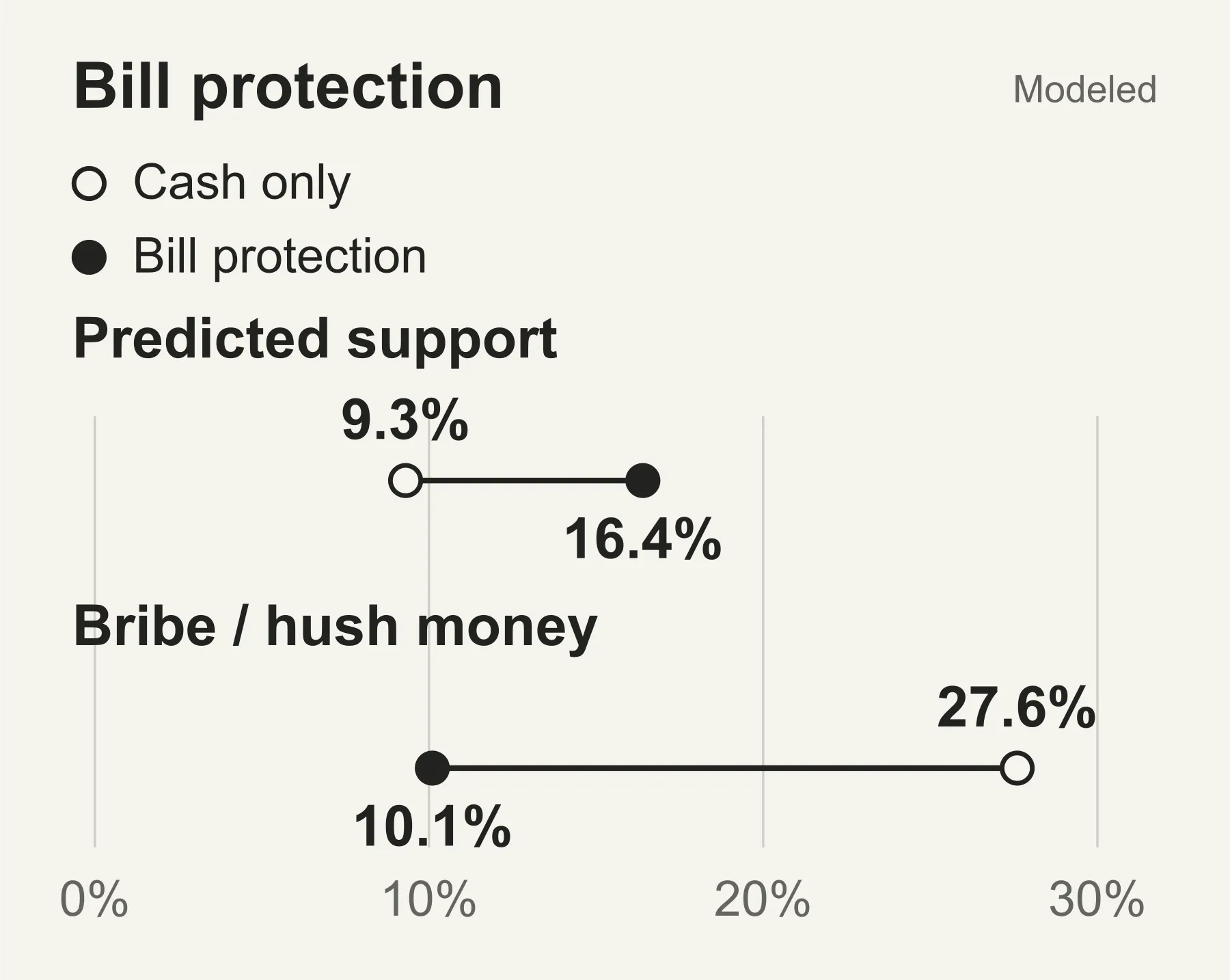
Cash alone and cash with bill protection went to separate modeled groups (n=903 and n=910). The support figures are mean predicted probabilities; the bribe/hush-money figures are shares selecting that answer. The full study then examines site impact and guarantees. A useful managed deliverable connects each outcome and its explanation with the next offer to investigate.
Explore our data-center decision study
How much do market research services cost?
The price depends on what you commission. Buying survey responses, licensing software and hiring a team to deliver a recommendation cover different amounts of work.
The figures below are published starting prices or indicative ranges from named providers. They cover different scopes, from purchased responses to complete studies and a first-project offer. Use the source terms to build a quote for your own audience and deliverable.
Published source: SurveyMonkey Audience
Published source: Drive Research: online survey
Published source: Drive Research: depth interviews
Published source: Drive Research: focus group
Published source: GetWhy: first study
Audience difficulty can change a quote substantially. Reaching general consumers is a different task from recruiting people with recent experience buying a particular enterprise system. Countries, languages, interview length, incentives, physical logistics and analysis all affect the work.
Ask each provider to separate design, audience access, data collection, analysis, reporting and follow-ups. Then add the work your own team will do. A lower fee may be good value when you have an experienced researcher ready to use the data. It may be a poor fit when your team needs someone to turn that data into a recommendation.
For a limited budget, narrow the decision first. Protect the audience and analysis that make the answer useful; remove questions that will not change the action.
How long does a research project take?
Compare the time from an approved study to the deliverable you need. A claim about how quickly interviews run says little about the time required to agree the questions, recruit participants and finish the analysis.
A useful schedule makes five stages visible:
- Scope: agree the decision, audience and alternatives.
- Design: approve the questionnaire, discussion guide or test.
- Audience: recruit participants or construct the research population.
- Research: collect responses, run the study and review quality.
- Decision: deliver the analysis, recommendation and stakeholder readout.
There can be meaningful differences even within a provider's headline promise. GetWhy specifies 48 hours from the first interview; study design and recruitment happen before that clock starts. Kantar's omnibus service advertises answers in as little as two days, using a shared survey format.
Because Vensia keeps the population available, follow-up questions and revised material can reuse it without rebuilding the audience.
A complete brief makes the service comparable
A useful study changes what happens next: a sharper proposition, a clearer message, an audience to prioritize or an idea to revise before investing further.
Bring Vensia the decision, audience, complete alternatives, deadline and the action that each plausible finding would change. Book a demo to scope the managed study, report, recommendation and follow-up your team needs.
Frequently asked questions
What is the difference between custom and syndicated research?
Custom research is designed for a particular client's questions and audience. Syndicated research is produced for multiple buyers, who license access to an existing report or dataset. Use existing research where it covers your decision; commission custom work for the questions it leaves unanswered.
Use our syndicated research guide to check the covered market, units, edition, outputs and permitted use of a report or dataset before deciding what to license or commission separately.
Should a small business outsource market research?
It can make sense when the decision matters and your team lacks the time, audience access or research skills to answer it. Start with existing customer and market evidence, then commission a focused study. Specify the deliverable and the action it will inform before agreeing the fee.
Does full-service research include recommendations?
It should when recommendations are part of the agreed scope. Ask for them explicitly, along with the evidence behind them and a readout with the research lead. A promise to deliver data or a dashboard does not, by itself, establish that the provider will advise on the decision.